Translate

miércoles, 20 de noviembre de 2019

Europe: will the challenge of new adversaries galvanize the Continent?


Europe and Its Enemies


by Pascal Bruckner


In 1989, as the Soviet empire was imploding, Alexander Arbatov, a diplomatic advisor to Mikhail Gorbachev, addressed a brilliant remark to Westerners: “We are going to do something terrible to you. You will no longer have an enemy.” 

The disappearance of Communism indeed plunged Europe and the United States into a disorienting euphoria; for the “free world,” it was a symbolic catastrophe. There was something terrible and yet reassuring in the Soviet Union’s hostility: the East/West divide separated good from evil with razor-sharp clarity.

An enemy represents a guarantee for the future, a certainty of solidarity; it mobilizes individuals who would otherwise be ready to go their own way; and it overcomes the apathy that inheres in prosperous societies. The Cold War provided a polemical ordering of memory and of knowledge—a pedagogy for the problems of the present. The obligation to follow and check the adversary’s movements made us attentive to the slightest guerrilla actions and to the most local of conflicts; humanity remained a common concern. The threat that loomed over our social life restored an unprecedented clarity to our institutions, rights, and well-being. Democracy was once again fragile and precious, like a treasure that could be stolen at any moment.

Three decades later, the Old World, which meantime has been overcome with skepticism, seems to have provoked in its uncertainty the encroachments of two enemies: radical Islamism, in the double form of terrorism and Salafism; and Vladimir Putin’s Russia. Both view the West with resentment, considering it, in the first case, guilty of hostility toward the religion of the prophet and, in the second, of having brought about the fall of the Soviet Union. There, though, the resemblance ends.

Vladimir Putin sees himself as a hyperbolic Westerner, despising European decadence in the name of the true European values that he claims to incarnate. “The liberal idea,” Putin told the Financial Times in June 2019, “has become obsolete.” All the ills that Russia suffers supposedly come not from Russians themselves but from Europe’s corruption, America’s malfeasance, and a satanic NATO. What the Kremlin’s master dreads above all is democratic contagion, an importation of the spirit of Maidan—Kiev’s Independence Plaza—into Russia itself.

From his time in the KGB, Putin has retained a founding principle of the Soviet state: the strategy of cutting a country into slices before swallowing what one intends to conquer—Ossetia and Abkhazia in Georgia; Crimea and the Donbass region of Ukraine; and, perhaps in the future, a piece of Estonia or Latvia. All this is in keeping with the adage, “What’s mine is mine, and what’s yours is negotiable.” Russia’s financing of certain populist parties, such as France’s National Front, against Brussels; and its flattery of Slovakia, payoffs in Hungary, threats to Scandinavia, and pressure on Sweden—leading that nation to reinstate military service and to enter into a defensive alliance with Finland—underscore that Putin’s goal is to dislocate Europe, to avenge the affront of 1989. The annexation of Crimea, the war in Ukraine, the meddling in French and American elections, the cyberattacks carried on by the hackers of the FSB (formally the KGB) or other information services: it all adds up to a significant offensive against Western interests.

Despite being a major revanchist, Putin enjoys surprising popularity in the West. A black belt in judo, he loves to parade bare-chested on horseback, to play with weapons, to swim in the Yenisei River, and to practice vigorous sports—all of which brings him admirers among the discontented. In France, the cult of this Muscovite Rambo extends from Marine le Pen and Philippe de Villiers on the far right to the extreme left of Jean Luc Mélenchon and the monthly Le Monde diplomatique, for whom Moscow remains the heir of the USSR, the only power truly to have contested capitalism. It is not love for Russian civilization, a passion for Pushkin, Gogol, or Rachmaninoff, that animates Putin’s French friends; it is anti-Americanism and a dangerous fascination for authoritarianism—for the tyrant’s scourge.

As for Allah’s extremists, the balance sheet is different. Hostility toward the now militarily degraded Islamic State (ISIS) is all but universal. Even Saudi Arabia and Qatar, which helped create ISIS to serve as a weapon against Iran, look with horror at the monster born of their dogmatism. (It was unfortunate that President Trump, during his official visit to Riyad in 2017, exonerated Saudi Arabia of any role in fomenting terrorism, placing blame on Iran alone.) We should be pleased that the highest authorities of Sunni Islam—notably, Al-Azar University in Cairo, have condemned this movement based on mass murder and fear.

Still, we should also be concerned that official Islamic disapproval of ISIS was late in coming, and somewhat muted. The hope that Islam will reform itself along the lines of the Catholic Church’s Vatican II runs up against the reality that many adherents of this great religion, the heir of a glorious past, cling to symbols of its identity that run sharply counter to modern liberal influences.

With the exceptions of Morocco, under the thumb of an enlightened king; fragile Tunisia, a little flame of Muslim tolerance threatened by extremists; and Hashemite Jordan, most Muslim countries have been oscillating between military despotism and theocracy: no-win situations. Even formerly liberal Turkey is slipping into authoritarianism and renouncing the secular legacy of Ataturk. Islam is a house divided; it is a damaged dwelling, filled with sadness but also with anger over the memory of its lost greatness. This is the wound that fundamentalists wish to heal by blaming it on the Crusades, on infidels, and on Zionists. Their opponents, the Muslim reformers, have the courage to call for opening Islam and deepening it, for undertaking a rereading of the Koran and of the sacred texts, in order to provide a shock of renewal.

We tend to forget that today’s Europe, unlike the U.S., wasn’t born of a covenant that said “all is possible” but of one that held “no longer is everything permitted”—not the destruction of cities, not ethnic cleansings, not mass killings. The total disaster of the twentieth century was needed to bring the Old World to virtue; without two world wars and their parade of horrors, the European aspiration to peace, hard to distinguish from an aspiration to rest, would never have taken root. What brought us from savagery to quietness was a saturation of murder. In Europe, democracy was what was left over when other, more violent, dreams were abandoned: a space of great diversity, where one could live, find fulfillment, and, if possible, get rich in proximity to cultural masterpieces.

Europe stopped caring about history, a nightmare that it left behind with great difficulty, first in 1945, and again after the fall of the Berlin Wall in 1989. Its dream was to take early retirement from the world, while offering itself as a model of reason, to which all peoples should conform. After ’89, it entered fervently into the era of the “post”: post-history, post-national, post-religious. Nations were an archaic political form. Frontiers would disappear and religions slowly dissolve, as superstitious forms of belief. Market competition and liberal democracy would guarantee prosperity and security.

This calm existence was supposed to be Kant’s “perpetual peace,” finally attained. There is a striking contrast, however, between the idyll that Europeans have recounted to themselves over the last 60 years and the latent, low-intensity civil war that is now the condition of certain areas of the European Union, protected by armed soldiers. Reality gives the lie to the fairy tale: millions of people, some within Europe itself, show that they’re ready to die for their God, while European populist movements contest the post-political utopia, proclaiming that peoples do not want to disappear, that borders protect before they separate, and that identity is not a product of nostalgia but a defining concern. History is grabbing Europeans by the collar.

Our enemy is anyone who wants to enslave us, colonize us, or annihilate us, whether by arms or propaganda—but we need to recognize him as such and attempt to parry his blows. The capacity to name the enemy is the prerogative of sovereign states, with the condition of not excluding a future reconciliation, once the conflict is won. It is necessary to respect one’s enemies and take them seriously: when they explain that they seek to crush us, we should take them at their word.

When, for example, the sheik Yusuf al-Qaradawi, the theologian of the Muslim Brotherhood, proposes that Rome, capital of the infidels, must be Islamized, or when President Recep Tayyip Erdoğan of Turkey, during a visit to Germany, exhorts Turks to remain loyal to Ankara and to have five children each, launching a true war of the wombs—we must take what they say literally. These are not delusions of leaders gone astray; they are statements of programs to be put into effect as soon as possible, in the real world. The nations of old Europe, fattened by a half-century of security, can exhibit a remarkable deafness to such threats. In this context, it was encouraging to hear French president Emmanuel Macron’s recent warning about the “Islamist hydra,” which he was careful to distinguish from the religion of Islam by virtue of its being a “deadly ideology, which does not recognize our laws, our rights, our way of life.”

It is important not to confuse an intermittent and ancient rivalry with Russia with terrorist jihadism, a very different threat. Where Moscow is concerned, we must negotiate from a position of strength; with ISIS, al-Qaida, and their like, we must vanquish—while keeping in mind the dreadful possibility (so well captured by the Showtime television series Homeland) that the fight against terrorism can provoke further terrorism and fan the flames that it wishes to extinguish.

Russia’s size and military power exclude a direct confrontation. Putin is an adversary whom we have no interest in transforming into an enemy. The master of the Kremlin is “possessed,” in the Dostoyevskian sense, but he is a cool sort of demon, an aggressor, kleptocrat, and tireless lecturer. He started the fight with Europe; we must respond, within the limits of reason, without weakness or concession—neither war nor peace but a continual test of strength, cooperation under tension, a partnership of distrust. This will likely include maintaining economic sanctions against Russia and reinforcing NATO’s troops on Europe’s eastern borders to dissuade Moscow from any aggression against Poland, the Baltic states, Scandinavia, or Moldavia.

After the military defeat of ISIS, the question remains of the extent of the Islamist threat, Sunni as well as Shiite. ISIS will leave behind metastases that will continue to spread and require constant vigilance from European governments. We must hope for the rejection by Islam of nihilist violence and its adaptation to modernity, which is encouraged by the most enlightened minds among Muslim elites. This work, which will take decades, demands something beyond Carl Schmitt’s friend/enemy distinction: it will require persuasion, political intelligence, and empathy.

Europe’s error after 1945 was to mistake decades of peace for the eternal course of history. Peace was better seen as a parenthesis; we have no reason to foresee the progressive abolition of conflicts. Brecht said that war produces war, but so does a bad peace. And in its worst moments, Europe has sought peace at almost any price, an approach that can sanction grave injustice, as during the ethnic conflicts that accompanied the breakup of Yugoslavia in the early 1990s—violence brought to an end only with American military intervention.

Until 2013, when French troops were sent to Mali to oust Islamist fighters from the north of the country, Europeans often insisted that military action was obsolete, and left it to others, reserving the right to criticize them relentlessly when they—the U.S. most notably, of course—went wrong in some misguided foreign mission. Yet this paradox remains: with the exceptions of France and Great Britain, which still have respectable armed forces, Europeans have delegated to America the job of defending them. Europe, for now without credible military means, continues to depend on the Yankee big brother for its safety. Why have we laid down our capacity for action?

Until recently, many Europeans viewed the soldier as barely tolerable unless he was a man of letters—a lesser figure than, say, the doctor or nurse. The refusal of armed conflict was directly linked with the rise of individualism and the decline of nationalism. In Europe, at least, the contemporary individual did not want to be dispossessed of his death in a collective conflagration. To act for a country or an ideology—that is, for a higher principle than one’s private existence—seemed an archaism in a hedonist society that touted self-fulfillment and love of life.

Everything changed in France with the terrorist attacks of 2015–16. Terrorism frightened us, but it also awakened a spirit of resistance. Despite the intentions of the terrorists, the attacks restored some fervor and flesh to my country, reviving patriotism and reminding us of the value of our way of life. The mass murders even brought the display of the tricolor flag in windows. When the French state kills a terrorist, it now leaves many of us happy or indifferent, instead of uneasy or outraged at the militaristic action; when then-president François Hollande acknowledged ordering assassinations in Iraq and Syria, for example, the public went along. “No quarter for those who threaten France,” he exclaimed before top military leaders in 2015. With death now lurking everywhere—in our cities, our streets, our train stations, and our houses of worship—we decided to go about our business; barbarism did not break us. We fought back.

True, modern military glory for the French and other Europeans is no longer that exalted by Alfred de Musset, who described the children born after the death of Napoleon as “drops of burning blood that had inundated the earth; they were born in the bosom of war, for war.” We hear an echo of this fervor in a comment by General Qasem Soleimani, head of Iran’s Quds Force, for whom “the battlefield is the lost paradise of humanity, the paradise where virtue and human action are at their highest.” Today, our military confronts mainly transnational networks, and counters them with various methods: special operations, international disinformation, the progressive virtualization of combat, and targeted killings that involve more ruse than force. A modern European military career mixes a passion for service and the taste for adventure with the recognition of past atrocities; the modern soldier is a tethered hero who must control his emotions and carefully measure his use of force. But the terror attacks made soldiers heroes again, serving their nation, erasing earlier defeats and embarrassments.

Democracy is the peaceful codification of differences—agreeing to disagree. Opposition is the precondition of pluralism in the life of a nation. But there are useful enemies, too. The adversary puts us in the contradictory position of wanting to conquer him, yet also wanting to sustain him somehow, to preserve the energy he breathes into us. It is in this strange antagonism that a people can show its character. The threats it faces might harm Europe gravely, but they might also force it to take hold of its destiny and constitute a military force worthy of the name, preparing for the worst in order to avoid it.

That isn’t guaranteed, however. “Civilizations die from suicide, not by murder,” wrote the historian Arnold Toynbee. What is wrong with our continent can be summarized in a few words: Europeans frequently have a low opinion of their own worth. When Islamists express their aversion for the West, or when nationalist Slavophiles express contempt for the Old World, they don’t have far to look; they have only to dip into the European literature and philosophy of the last two centuries. The prosecution of Europe goes on, led by a drumbeat that Europe itself often provides. Ever proud to beat its breast, it ostentatiously claims a universal and apostolic monopoly of barbarism. The Old World has vanquished its monsters—slavery, fascism, colonialism, and Stalinism—except for one: self-detestation. Its bad conscience is not remorse for a definite crime; rather, it has become for many an identity, a convenient refuge by which we withdraw from history. Our enemies understand this, knowing us better than we know ourselves. We fight first against ourselves, against our scruples and our devouring doubts. Someone strikes me—therefore, I am guilty. This is why, in one sense, we should thank Putin or al-Baghdadi, even if we cannot equate them, for their hostility. They help revive us by detesting us.

Europe must rearm itself, then, but it must also distinguish the battlefield from the confrontation of ideas. Conflicts with our enemies are not won only with tanks, bombs, and an adequate deterrent; they can be won at the cultural level, if we can convince our aggressors of our determination and the rest of the world of the eminent virtues of our civilization.

European pessimism, by contrast, is the expression of a political order with no grip on its future. But a continent that does not love itself cannot be loved by others and is morally preparing its own disappearance. It can be colonized because it has become mentally colonizable. We flirt with the pleasure of disappearing and present this erasure as a proof of high civilization. The drastic decline of the birthrate in Europe, compensated by uncontrolled immigration, is revelatory of lack of confidence in the future. Søren Kierkegaard liked to cite a certain Sebastian Franck: “A philosopher was asked how he began to become one. He responded: ‘When I began to be my own friend.’ If one asked a Christian when he became one, he would respond: ‘When I began to become my own enemy.’” One must not reject one’s demon but live attached to him as a fecund contradictor. It is one thing, though, to take in an intimate critic as a fertile irritant, and another to give shelter to a pitiless critic, who gives no respite. Western self-criticism too often swings over into systematic denigration and the deadening of our spiritual resources. Nothing is more Western than this passion for self-laceration. The spirit of criticism turns on itself and threatens to destroy itself, a morose pleasure that leaves nothing standing. Hypercriticism ends in self-hatred, ready for all renunciations.

“No power can destroy the Spirit of a people either from within or from without if it is not already lifeless, if it has not already withered away,” Hegel observed. Let us begin, if possible, to become once again friends to ourselves, in order to be friends once more to the rest of the world. It makes no sense for Europe to be so envied and yet to love itself so little, when it is the very example of a successful exit from the apocalypse of the twentieth century, of a harmonious marriage between power and conscience. If we do not change our mind-set, we will disappear over the coming century, pushed aside by rougher but more dynamic cultures. We have never been so close to collapse—or to a new start.

Pascal Bruckner is a French writer and philosopher. His article was translated by Alexis Cornel.

Source: www.city-journal.org

The death of Europe is in sight, but only men and women die...


On the “Dying” of Europe

by James V. Schall, S.J. (1928-2019)


The striking opening sentence of an essay by Bret Stephens in the October 19, Wall Street Journal reads: “The death of Europe is in sight.” But what precisely is dying? We recall Belloc’s famous “Europe is the faith and the faith is Europe,” except that most of Europe has lost that faith that made Europe. “Re-evangelization” and the “New” Evangelization have had little impact. So is it still “Europe”?
Eric Voegelin, in Science, Politics, and Gnosticism, remarked that the origin of modern ideology lies in a lack of courage, in a loss of faith of Christian men in the reality of the transcendent order as presented in that faith. This subsequent ideology causes the death of an Europe unwilling to preserve what it is.
A prosperous Europe, in its own confusion, is literally “invaded,” predominantly by Muslims from various failed states. We look at the pathetic decline in European birthrate, itself a sign of serious spiritual disorder.
What replaced the old European nations, Christendom, was a secular humanism devoted to a “universalism” that sought to downplay or rid itself of its Christian heritage. In many ways, it has “peacefully” accomplished this purging. The Church itself in old European lands seems confused and open to the doctrines of this humanism, as the recent Synod on the Family often demonstrated.
In a remarkable essay, “The Love of One’s Own and the Importance of Place,” George Friedman wrote: “Dying for a regime dedicated to the pursuit of happiness makes no sense. Dying for the love of one’s own makes a great deal of sense. But the modern understanding of man has difficulty dealing with this idea. Instead it wants to abolish war, banish war as an atavism or at least brand war as primitive and unnatural. This may all be true, but it should be noted that war simply won’t go away. Neither will the love of one’s own and all that follows from it.” We might say that war continues because its Kantian abolition ultimately implies that there is no distinction between good and evil in our lives. It is against this latter doctrine that good men will still fight – if they can.
....
Obviously, this approach postulates new “rights” that guarantee the purpose of the abstract state’s “humanism.” The new “European” man is cleansed of all the variety that made him worthy of interest. But this new man, since he is an abstraction, is incapable of dying. Only men and women die. Likewise, only men and women beget. Bad ideas do not “die.” Either they are seen as erroneous and rejected or as enticing and put into the world. Of the “dying Europe,” requiescat in pace.

Source: www.thecatholicthing.org

When you understand what accepted sorrow means, you will understand everything. It is the secret of life.


Life, Dignity and Disability: A Faith that Welcomes Suffering

The acceptance of suffering may be the secret of life, but the joyful service of Christ on the Cross is the secret of love.

Christianity is a faith that welcomes life and is welcoming to the disabled because it is a faith that welcomes suffering. It is the Christian’s acceptance and embrace of suffering that is at the heart of his acceptance and embrace of the suffering of others. This is the “secret of life” disclosed by the fictional priest in Maurice Baring’s last novel, from which the above quote is taken. The acceptance of sorrow or suffering is indeed the secret of life. When we understand that we will understand everything, or, if not everything, we will at least understand the hollowness of the lies and delusions with which the world tries to seduce us.

Maurice Baring, a bestselling Catholic novelist and great friend of G. K. Chesterton, wrote these words about the acceptance of suffering as he was struggling with the debilitating effects of Parkinson’s disease, the affliction that would eventually kill him. They were, therefore, intensely personal. Equally personal was the poem that he wrote as he struggled to cope with the onset of his illness:

My body is a broken toy
Which nobody can mend
Unfit for either play or ploy
My body is a broken toy …
My soul is an immortal toy
Which nobody can mar,
An instrument of praise and joy;
My soul is an immortal toy;
Though rusted from the world’s alloy
It glitters like a star;
My soul is an immortal toy
Which nobody can mar.*

In seeing his broken and mortal body in the light of the permanence of his immortal soul, Baring learned to accept his affliction. Such acceptance is, however, much more difficult for those who have no belief in the soul or its immortality.

Although acceptance of suffering is a choice, suffering itself is not. We are all doomed to suffer, whether we like it or not or whether we choose it or not. 

Suffering is not a choice, it is a gift. It is given to each of us. Most of us, to be sure, would rather not have it. Most of us do our best to avoid it. Since, however, it is unavoidable, the wise learn to accept it. It is, however, only the holy who openly embrace it and seek it out. It is the holy who understand the true secret of love as well as the true secret of life, which is not merely the acceptance of suffering but the joyful embrace of all suffering, not simply our own but that of our neighbor, and of Our God. This is the ultimate secret that is revealed by the Suffering Christ and by those of his disciples who take up their crosses to follow Him. Suffering, properly understood in its Christ-like simplicity and complexity, is to be not only endured but enjoyed, not in any sordid masochistic sense but in the liberating sense of the lessons it teaches and the riches it bestows.

Scripture is awash with examples of souls being ennobled and enriched by the experience, acceptance and embrace of suffering. One of the most powerful is the example of the two thieves crucified either side of Christ on Golgotha. These two thieves can be said to represent the whole of humanity. Both are sinners who have harmed their neighbors through acts of selfishness. Both are guilty of the crimes for which they are being punished and deserve the death that is meted out to them in justice. Neither can escape from their suffering. They are like the rest of us. They are, however, very different in the way that they view their own suffering and that of the innocent Man who is suffering with them.

The bad thief does not care about justice. He does not feel guilty for the suffering he has caused to others. He wishes only to escape his own suffering. He scorns the innocent Man who is his God as he had scorned his fellow men who were his neighbors. Indeed God is his neighbor, nailed to the cross beside him for the sins the bad thief has committed. Insofar as the bad thief had caused suffering to his neighbor, he had caused suffering to his God.

The good thief knows that he is as much a sinner as the bad thief and that he deserves equal punishment in justice for the suffering he has inflicted on his neighbor. The difference is that he accepts his suffering and begs his God, and by extension his neighbor, to forgive him. In accepting the suffering he is accepting the forgiveness. In the acceptance of both he is accepted by God into His Kingdom. Thus the acceptance of suffering is the precursor of the joy that is its consequence.

The acceptance of suffering may indeed be the secret of life, as Maurice Baring’s fictional priest tells us, but the joyful service of Christ on the Cross is the secret of love. It is a love that lays down its life for the lives of others, a love that welcomes every human life, however broken, in the fullness of the Love that will heal all brokenness.

*Maurice Baring, “My Body Is a Broken Toy”, published in Joseph Pearce, Flowers of Heaven: One Thousand Years of Christian Verse, London: Hodder & Stoughton, 1999, p. 198


Source: www.ncregister.com

A series of tragic incidents led Vladimir Lenin to eventually take control over the world’s largest country by landmass ...


Russia Became a Communist Hellhole Because of This Man

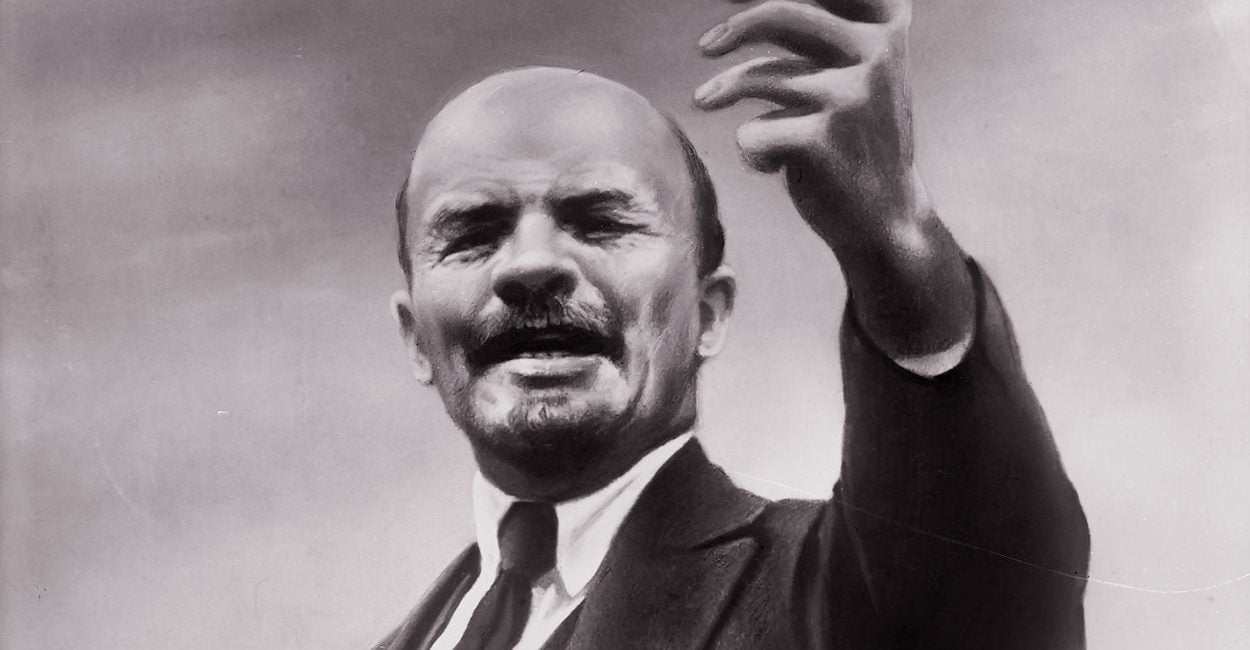
To understand communism, it’s important to look at the man who was the first to institute a government dedicated to Karl Marx’s ideals: Vladimir Lenin.
When I was in college, I recall a conversation with several classmates who joked about throwing a get-together and naming it “The Communist Party.” They mocked the idea that anyone would fear this supposedly well-meaning ideology.
I wonder if they would have been laughing if they were in the presence of gulag survivors.
This Nov. 7 marks the 102nd anniversary of Lenin’s rise to power in Russia, and Nov. 9 will mark the 30th anniversary of the fall of the Berlin Wall, the symbol of tyranny built by the regime he forged.
Victor Sebestyen’s 2017 biography on Lenin—the first major biography of the Soviet leader to hit Western bookshelves in two decades—documents his many crimes against humanity.
Lenin’s streak of cruelty began long before he came to power. By his early 20s, his zealous dedication to Marxism led him to believe that anything justified revolution.
Cruelty Without a Conscience
When a famine broke out in the Volga region in 1891—one that would kill 400,000 people—Lenin welcomed the event, hoping that it would topple the Czarist regime. His sisters, dedicated revolutionaries themselves, assisted with relief efforts for the starving and were shocked by his callous refusal to help.
Later, in 1905, when Czarist forces killed hundreds of striking workers and 86 children in Moscow, Lenin refused to mourn for the dead and, instead, hoped the event would further enflame class antagonisms. In his eyes, human lives were expendable in the pursuit of the workers’ paradise.
Lenin would spend a career castigating and eliminating competitors who he believed had deviated from what he considered “true” Marxism. As Sebestyen notes, though, “The first major ‘deviationist’ was Lenin, who frequently turned Marxism on its head when it didn’t suit his tactical purposes.”
In other words, Lenin was a hypocrite who would purge others for revising Marx, but reserved that right for himself.
Marx had asserted that broad, impersonal (not individual), and material forces controlled the course of history. He also didn’t envision the revolution of the urban proletariat happening in the largely agrarian Russian Empire.
No matter—it could happen in Russia, because Lenin said so and would make it happen (which he did). So much for broad, impersonal forces.
Thus, Lenin ushered in the longtime communist practice of manipulating ideology to obtain whatever was desired.
Stoking the Flames of Revolution
Before taking power, Lenin spent much of his life under house arrest in Siberia or in exile abroad, living in the United Kingdom, France, and Switzerland—countries that one day would face an existential threat from the regime he would create.
He established himself as a major leader in the underground communist movement. Reading Sebestyen’s account makes it seem that Lenin was the head of some sort of secretive startup enterprise.
Lenin was constantly raising funds and generating support. He wrote and printed subversive literature, distributing it through underground networks.

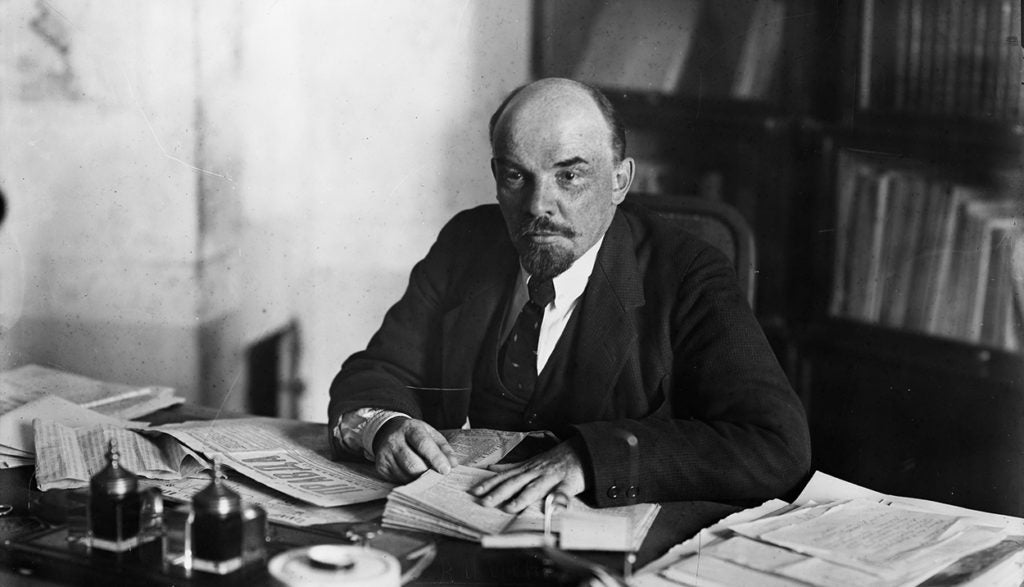
Vladimir Lenin in his office Oct. 16, 1918. (Photo: Laski Diffusion/Getty Images)

At times, it looked as though Lenin’s venture was on the brink of collapse, and no one else seemed to believe he would amount to anything—except, it seemed, Lenin himself.
He survived, in part, by living off his mother’s funds. History seems to indicate that dependency combined with radicalism is rarely a good thing. Osama bin Laden, too, was an extremist who lived off his family’s wealth while financing his Islamist activities.
A series of tragic incidents led this foundering communist to eventually take control over the world’s largest country by landmass. Germany invaded Russia, the Czar showed disastrous leadership, and Berlin ultimately sent the exiled Lenin back to Russia to destabilize it and remove it from the war.
It also helped Lenin’s cause that he had the perfect slogan for a suffering populace: “peace, land, and bread.”
While in exile, Lenin railed against the imperial government for its oppressive ways—for instance, its censorship of the opposition and dismissal of parliament. Of course, once in power, Lenin repeated these policies and usually exceeded their cruelty, imprisoning and confiscating the property of his opponents.
When it came to hypocrisy, the sky was the limit for Lenin. Sebestyen recounts one instance in which Lenin was indignant after his bicycle was stolen. The irony was surely lost on him.
A Regime of Torture and Murder
Lenin appointed the homicidal Felix Dzerzhinsky to head up the Cheka (the secret police) with orders “to fight a merciless war against all enemies of the revolution. … We are not in need of justice. It is war now.”
In less than a year, hundreds, if not thousands, were executed—including Nicholas II and his family. He would be the last emperor of Russia.
In a move that prefigured Mao Zedong’s later Cultural Revolution in China, Lenin incited class warfare across the Soviet Union.
He marked wealthy peasants, or kulaks, as enemies of the revolution and encouraged violence against them. He imposed fixed grain prices at low rates, straining peasants who already were living on the margins, seized their grain, and left them to starve.
When the peasants began resisting, Lenin ordered government officials to torture them or apply poison gas. He specifically ordered his henchman, Josef Stalin, to be ruthless in taking grain from Tsaritsyn.

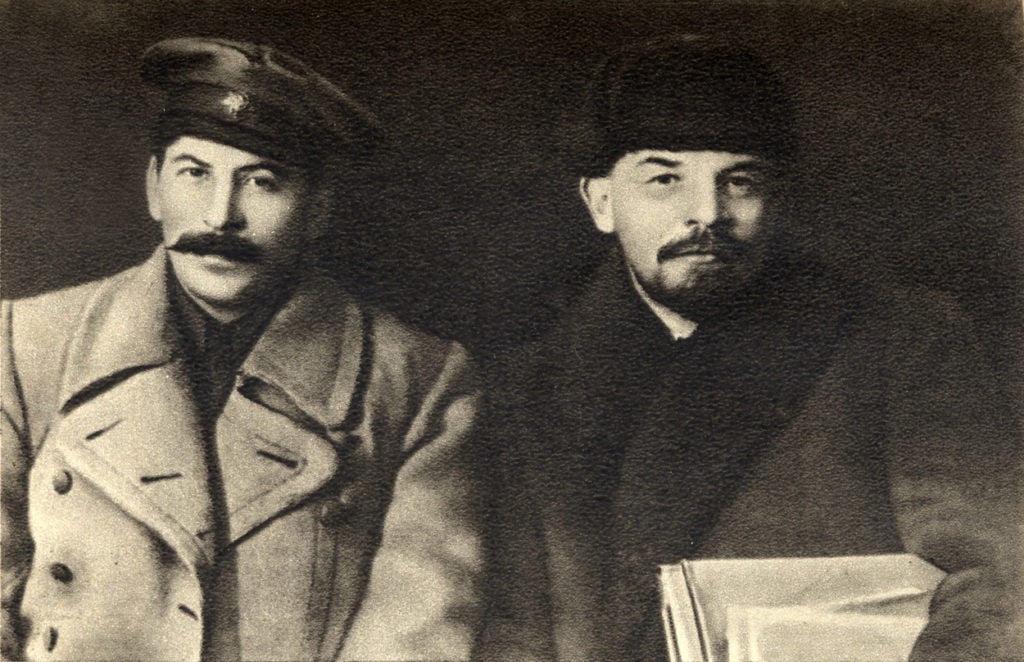
Vladimir Lenin and Josef Stalin together in 1919. (Photo: Universal History Archive/Getty Images)

When those tactics contributed to yet another famine in the Volga area, he refused to provide relief and did so only after being forced by his advisers. American official Herbert Hoover, who was running humanitarian efforts in Europe during World War I, offered his services to the Soviet government.
For those who scoff at the idea that communism was an inherently expansionist regime, Lenin created Communist International, or “Comintern,” to spread the revolution around the world. At times, more funds were spent to spread propaganda abroad (including in the United States) than on famine relief.
The End of One Man, the Beginning of a Disaster
An assassination attempt and a series of strokes weakened Lenin and, by 1923, he was dying. By then, he came to believe Stalin was too heavy-handed to be his successor (he would know), even saying as much in his famed Last Testament (which was later suppressed).
Lenin died in January 1924, having failed to dislodge Stalin from power. As bad as Lenin was, somehow, even greater suffering awaited the Russian people.
After a lifetime of serving the Soviet government at the highest levels, Vyacheslav Molotov reflected on the two men, saying that both were “hard men … harsh and stern.” He added, “Without a doubt, Lenin was harsher.”
The regime that Lenin founded would eventually impose totalitarian dictatorships over its Eastern European neighbors and threaten the existence of the West, but ultimately would collapse in 1991 under the weight of its own contradictions.

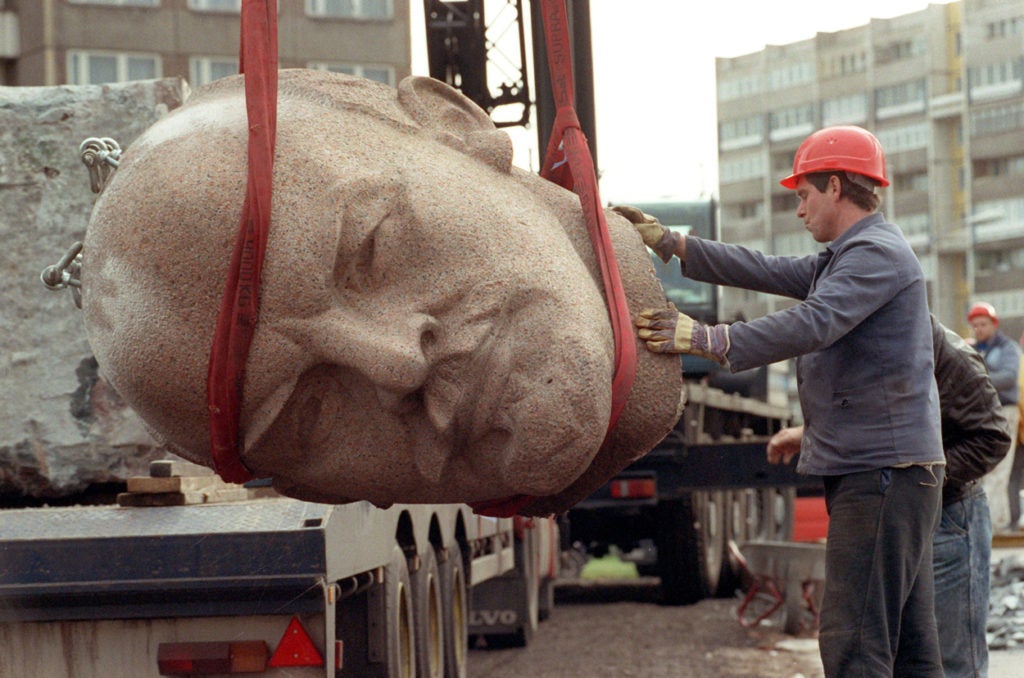
A worker removes the head of a statue representing Vladimir Lenin in Berlin on Nov. 13, 1991. (Photo: Andreas Altwein/DPA/AFP via Getty Images)

The Soviet Union may no longer exist today, but the Communist Party in China remains firmly entrenched. Few regimes can match the levels of totalitarianism practiced under Lenin, Stalin, and Mao, yet Beijing continues to disregard human life in its pursuit of the promised Marxist utopia.
The United States has never been a perfect country, but we can be thankful that it avoided the autocratic and ideological extremes of the 20th century.
The far left is always looking to publicize injustices here at home. By that standard, the story of Lenin ought to receive more attention than any other.

domingo, 17 de noviembre de 2019

Atributos del soberano para La Bruyère, por Pablo Lopez Herrera


“Para reinar bien, hace falta un genio, superior y poderoso que se haga amar y reverenciar por los suyos y temer por los extranjeros, que haga de una corte, e inclusive de todo un reino como una sola familia, unida perfectamente bajo un mismo jefe, cuya unión y entendimiento sea temible por el resto del mundo.”

“Esas admirables virtudes no parecen estar comprendidas en la idea de lo que es un soberano, ya que es raro verlas reunidas en un mismo sujeto, puesto que deben concurrir muchas cosas a la vez: el espíritu, el corazón, la apariencia, el temperamento, y me parece que es digno de ser llamado Grande el que las reúna a todas.”


Clase
Atributo


Habilidad conceptual (criterio, percepción, inteligencia) - alineación


Discernimiento de los espíritus, de los talentos y para la complejidad que implica la distribución de puestos y de empleos.

Juicio firme y sólido.

Conocimientos como para poder ver todo por sus propios ojos.

Una memoria feliz y muy presente, que recuerde las necesidades de sus súbditos, sus caras, sus nombres y sus pedidos.

Amor al bien de su estado y su gloria mas que a su propia vida, y no cuidar a su vida para otra cosa que para el bien del estado.

Un espíritu que fije las reglas de una gran ambición y que sepa hasta donde extender sus conquistas

Una profunda sabiduría, que sepa declarar la guerra, vencer, utilizar la victoria, hacer la paz, romper la paz y obligar a los enemigos a recibirla

Saber cuando conviene desplazar las fronteras por la conquista de nuevas provincias, y su aseguramiento por un gran número de fortalezas inaccesibles.

Hacer de una corte, e inclusive de todo un reino como una sola familia, unida perfectamente bajo un mismo jefe, cuya unión y entendimiento sea temible para el resto del mundo.


Capacidad de relación con la gente

 – con el equipo


Un espíritu fácil, insinuante, un corazón abierto, sincero, del que se crea ver el fondo, apropiado para hacerse de amigos, seguidores y aliados.

Reservado, secreto, profundo e impenetrable en los motivos y en los proyectos.

Una manera especial de otorgar las gracias.

Un espíritu derecho y equitativo, que lo haga pronunciarse en ocasiones contra si mismo y a favor de su pueblo, e inclusive a favor de aliados o de enemigos.

Cuidar a sus pueblos como a sus hijos, estar siempre ocupado con el pensamiento de aliviarlos, de hacer los impuestos livianos, de tal modo que se recauden en las provincias sin empobrecerlas.

Una forma de ser que saltee esa distancia infinita que a veces hay entre los grandes y los pequeños y que tienda al acercamiento.

Procurarse el placer de los juegos, las fiestas, los espectáculos y cultivar las artes y las ciencias, aún en el medio de enemigos encubiertos o declarados.


Capacidad emocional – Carácter -  Temperamento - Personalidad


Perfecta igualdad de humor, humor parejo.

No ceder a la cólera.

Decidido.

Vigilante, aplicado, laborioso.

Frío en el peligro.

Que actúe inmediatamente y por propia iniciativa.


Capacidad técnico profesional - Experiencia


Una amplia capacidad que se extienda no sólo a los negocios con el exterior, al comercio, a las máximas que deben regir al estado, a los diferentes puntos de vista de la política, sino que también sepa encerrarse adentro, en los detalles de todo el reino.
De grandes talentos para la guerra


Principales actividades a desarrollar para la dirección de un estado


La elección de los generales y ministros.

Elección de las personas a las que se gratifica.

Reformar las leyes y las costumbres  si estas están llenas de abusos.

Desterrar al culto falso, sospechoso y enemigo de la soberanía, si lo encuentra, y eliminar las costumbres crueles e impías, si estas prevalecen.

Dar a las ciudades mas seguridad y más comodidad por la renovación de la POLICIA,

Darles más brillo y majestad a las ciudades con los edificios suntuosos.

Formar y generar proyectos de edificios que sorprendan.

Castigar severamente a los vicios escandalosos.

Proteger a la Iglesia y a sus miembros sus derechos y sus libertades.

Tener ejércitos abundantes y comandarlos en persona.


Hábitos y costumbres

Ser obedecido siempre.

Nunca amenazar o reprochar.

Estar lejos del cotilleo popular, o no dar razón suficiente como para permitir que exista.

Seriedad y gravedad en publico, brevedad, justeza y dignidad, tanto frente a los embajadores de los príncipes, como en los consejos.

Hacer que se conozca la mejor posibilidad y la mas justa.

Dar por su autoridad y su ejemplo crédito a la piedad y a la virtud.

Un poder muy convincente, que no de ocasiones a los pillos, a la intriga, al complot.

Que sus generales no sean sino sus oficiales, aunque estén alejados de el.

Que sus ministros no sean otra cosa que sus ministros.


Dones “naturales”

Nacimiento augusto

Aires de imperio y de autoridad

Un rostro que satisfaga la curiosidad de la gente interesada en ver al príncipe, y que inspire respeto por el cortesano.


All four earth-shaking ideas: liberalism, the people’s state, nationalism, and socialism, spread like wildfire, and th flames chiefly emanated from Revolutionary France


How Nationalism and Socialism Arose from the French Revolution

In the same century, four ideas swept through the West and shook the world

In 1755, the Portuguese city of Lisbon was struck by a massive, deadly earthquake. As Deirdre McCloskey recently wrote, in the century that followed, three big ideas swept through Europe that would also shake the world. One of those ideas was fantastically fruitful, while the other two proved to be disastrously destructive.


First to sweep through was the bright idea of, in the words of Adam Smith, "allowing every man to pursue his own interest in his own way, upon the liberal plan of equality, liberty, and justice.” In the first half of the 19th century, this idea became known as liberalism.
Then, just as liberalism began to transform the world, two pernicious ideas began to vie with it. Nationalism and socialism began to capture the imaginations of intellectuals and would eventually displace liberalism completely in the hearts and minds of the West.
Liberalism unlocked humanity’s creative potential, yielding the first ever rise of widespread abundance through industrial mass production. Nationalism and socialism unleashed humanity’s capacity for destruction, unleashing the first ever rise of industrial-scale mass murder.
The twin banes of nationalism and socialism followed the boon of liberalism remarkably quickly. To understand why, we must consider a fourth big idea that historically links the other three: the idea of the people’s state.

The ideas of individual liberty and of the modern people’s state emerged in close conjunction, because the two had a common enemy: the hereditary, divine princely state. In the old order, kings claimed absolute authority over their subjects by hereditary and divine right: by inheriting his crown from his predecessor and having his rule blessed by the church on behalf of God.
In 17th-century England, the proto-liberals called the Whigs challenged these pretensions, both with arms and arguments. The great manifesto of the so-called “radical Whigs” was John Locke’s 1689 work Two Treatises of Government. Against royal authoritarianism, Locke advanced the individual’s rights to life, liberty, and property. And against royal autocracy by divine and hereditary right, Locke drew an alternate picture of government as merely an instrumental institution, created by the people and for the people: that is, empowered by the public for the sole purpose of securing their individual rights.
According to Locke, the state is not the royal family’s private property. Whether democratic or not, proper government is a public institution: what we might call a people’s state. Anything else is not legitimate rule but tyranny.
In Locke’s view, the state is a servant of the people with a specific job. If that servant is not performing its function, or worse still, if it is deliberately trampling on the very rights it was tasked to protect, then it has broken the “social contract”: the terms and conditions upon which it was hired. In such cases, the people may exercise their right of revolution: the right to fire (abolish or secede from) their government and hire (establish) a new one. This contractual, business-like notion of government was easy for the town-based, largely bourgeois Whigs to grasp and accept.
It was a short step from wanting a “government by the people and for the people” to wanting a “government of the people.” After all, what better way to keep the state on task and remind it who’s boss than for the people to actively oversee and guide the government? Indeed, after the Whigs overthrew King James II in the so-called Glorious Revolution of 1688, the chief result, aside from the liberal English Bill of Rights, was the empowerment of Parliament over the new constitutional joint monarchy of King William III and Queen Mary.
From Locke onward, the cause of liberty was bound up with the cause of the people’s state. Indeed, the bond was so tight that they were considered a single cause: the people’s state (and eventually democracy in particular) was considered an essential plank of liberalism. Liberals considered the people’s state, or “political liberty,” to be an indispensable guardian of individual liberty, just as much as they considered the unaccountable princely state to be a standing threat to freedom.
By the Enlightenment decades of the 1760s and 70s, the Lockean ideals of individual liberty and the people’s state had crossed the Atlantic to the American colonies, where they became the creed of the founding generation. So strong was their love of liberty and intolerance for despotism that they rose in resistance to an arbitrary tax regime that today would be considered miniscule. After Britain tried to overcome that defiance with lethal military force, resistance turned to revolution.
Throughout the Declaration of Independence that announced and justified the American Revolution in 1776, Thomas Jefferson echoed, even paraphrased, Locke’s second Treatise. King George III had not only failed in his duty to protect the rights of Americans, but had actively violated them. And these infringements were so recurrent as to demonstrate “a design to reduce them under absolute Despotism.” As Locke had explained, these were precisely the conditions that called for revolution.
King George had broken the terms and conditions of the social contract. So the American people no longer had any obligation to keep him on as their security provider. He was fired, and the Declaration of Independence was his pink slip. George didn’t take his firing well, so it took the Revolutionary War to escort him off the premises.
The founders had so much faith in the people’s state as a guarantor of liberty that they then went beyond England’s example of constitutional monarchy and parliamentary government. After exiting the Constitutional Convention, Benjamin Franklin was asked what kind of government had been created. He answered, “A republic, if you can keep it.” A republic is a people’s state by definition, derived from the Latin respublica, or “concern of the people.”
The dream of a people’s state for liberty next travelled to France. The monarchy in France was so autocratic that the Estates General (France’s parliament) hadn’t convened in 175 years. But in 1789, the cash-strapped Bourbon king Louis XVI resuscitated the institution in order to raise desperately needed funds. The French Revolution started when members of the Third Estate (representing French commoners) broke away from the session, formed an independent National Assembly, and vowed to give France a constitution.
A Parisian mob gathered in support of the Assembly, stormed the Bastille, and seized the weapons cache within to give the budding people’s state a military upper hand over the demoralized monarchy. In a portent of wider brutality to come, the mob also decapitated the commander of the Bastile and paraded through the city with his head on a pike.
After a brief abortive period of constitutional monarchy, France too became a republic, even more thoroughgoing than the American one. Whereas the American republic was constituted as a federal government with a bicameral legislature and strictly limited suffrage, France’s First Republic was a national government with a unicameral legislature and, for a time, universal adult male suffrage. To secure the new republic against a return of the monarchy, the deposed king was beheaded.
At first, the theory of the people’s state as a champion of liberty seemed to work out in practice. The earliest legislative acts of Revolutionary France were predominantly liberal. Because of peasant resistance, feudalism had already been declining under the monarchy. But the National Assembly finished it off by abolishing serfdom outright. Then it passed a Declaration of the Rights of Man and of the Citizen, which contained the Lockean pronouncement that, “The aim of all political association is the preservation of the natural and imprescriptible rights of man. These rights are liberty, property, security, and resistance to oppression.”
But the French soon learned that a people’s state can be even more oppressive and absolutist than an autocratic monarchy, and even less likely to brook any resistance.
The Revolution had been precipitated by the monarchy’s bungling efforts to address a financial crisis caused by its own profligacy. Yet the National Assembly’s attempt to solve the problem proved even more inept. It enacted a paper money scheme that caused rampant inflation and devastated the economy, especially for the poor.
The primary cause of the monarchy’s looming bankruptcy had been its expensive wars. Yet within three years of the Revolution, the new French government preemptively declared war on Austria. This was followed by 22 years in which France was almost constantly at war, ostensibly to secure and export the Revolution: to, as Woodrow Wilson might have put it, make the continent safe for republicanism.
Food prices had already been high due to the paper money fiasco, but the costs of war made the situation even worse. The poor working classes rioted in the streets. With the mob support of these sans-culottes, as they were called, a radical faction known as the Jacobins seized control of the Republic.
The Jacobins instituted the General Maximum, a regime of price controls that eventually covered all foodstuffs and a long list of other basic goods. Violating the Maximum was punishable by death. This of course caused widespread shortages and famines. The Republic responded by sending troops into the countryside to seize crops from farmers to feed the capital. The people’s state that had freed the peasantry from their parasitic feudal masters had itself become for them, in a few short years, an even more voracious parasite.
The new Committee of Public Safety, under Jacobin leader Maximilien Robespierre, then initiated the Reign of Terror: a wave of political violence, including prison massacres and thousands of beheadings, that made the political repression of the overthrown regime look tame in comparison.
Around the same time, the Republic also instituted the levée en masse, an unprecedented war mobilization of the entire French population, including a military draft of all young, unmarried men. The people’s state had abolished the corvée (a serf’s obligation to his master of unpaid labor) only to then institute universal state servitude.
The Republic’s worst single atrocity was the War in the Vendee. An anti-revolutionary rural population revolted against Paris’s attempt to conscript their sons into war. In crushing the insurrection, the Republican government killed as many as over a quarter of a million peasants. Rebel prisoners—men, women, and children—were executed in mass crowds by gunfire and drowning. A state massacring its own people at such a scale was at that time almost unprecedented.
The Republic had promised, as the revolutionary slogan said, “liberty, equality, fraternity.” Instead it delivered conscription, subordination, fratricide.
The dreamt-of French people’s state was to be the ultimate safeguard of French liberty. In reality, the Republic ended up violating “the rights of man” more rampantly and atrociously than Louis XVI would have ever been capable of.
The Revolution inflicted all of this, only to finally elevate one of its own sons as a despot. The chronic wars and crises of the Republic led to the military dictatorship of Napoleon Bonaparte, who waged war throughout Europe and forged a new continental empire under a new dynastic monarchy blessed by the church. The French Revolution had lived up to its name by coming full circle.
After the fall of Napoleon and the restoration of the Bourbon monarchy, one of France’s leading liberals addressed the question: what went so wrong? Benjamin Constant answered that many of the Revolution’s “evils” stemmed from a confusion between two kinds of liberty. In an 1819 essay,he discussed, “The Liberty of Ancients Compared with that of Moderns.”
According to Constant, the liberty of the modern world was individual freedom. This was the idea of liberty that emerged from the European towns with the rise of private commerce and industry. As Constant defined it, modern liberty was the right of the individual:
“…to be neither arrested, detained, put to death or maltreated in any way by the arbitrary will of one or more individuals. It is the right of everyone to express their opinion, choose a profession and practice it, to dispose of property, and even to abuse it; to come and go without permission, and without having to account for their motives or undertakings. It is everyone's right to associate with other individuals, either to discuss their interests, or to profess the religion which they and their associates prefer, or even simply to occupy their days or hours in a way which is most compatible with their inclinations or whims.”
On the other hand, Constant explained, the liberty of the ancient world, “consisted in an active and constant participation in collective power.” This was the idea of “political liberty” in a people’s state that first arose in the ancient Greek democracies and was cherished in the Roman Republic. In these classical civilizations:
“…the individual, almost always sovereign in public affairs, was a slave in all his private relations. As a citizen, he decided on peace and war; as a private individual, he was constrained, watched and repressed in all his movements; as a member of the collective body, he interrogated, dismissed, condemned, beggared, exiled, or sentenced to death his magistrates and superiors; as a subject of the collective body he could himself be deprived of his status, stripped of his privileges, banished, put to death, by the discretionary will of the whole to which he belonged.”
As Constant explained, the revolutionaries betrayed modern liberty by trying to resurrect an ancient system that:
“…demands that the citizens should be entirely subjected in order for the nation to be sovereign, and that the individual should be enslaved for the people to be free.”
Among the most radical French republicans, this demand went to totalitarian extremes. For example, Constant said this about Abbé de Mably, a prominent writer of the period:
“…to him any means seemed good if it extended his area of authority over that recalcitrant part of human existence whose independence he deplored. The regret he expresses everywhere in his works is that the law can only cover actions. He would have liked it to cover the most fleeting thoughts and impressions; to pursue man relentlessly, leaving him no refuge in which he might escape from its power.”
Enthralled by classical literature, the leading revolutionaries tried to set the French people free by giving them untrammeled collective power. The liberals among them believed the objectives of collective power and individual liberty to be beautifully complementary, even identical. In practice, collective power waged war on individual liberty almost from the outset.
The revolutionaries’ devotion to collective power came, not only from their classical reading, but from their fascination with the political ideas of Jean-Jacques Rousseau, a protege of Mably. Rousseau redrafted the social contract and reconstituted the people’s state in a more radically collectivist direction. In his version of the great contractual exchange, the individual offers total submission to “popular sovereignty,” which is the collective power of the people’s “general will.” In return, the individual as part of “the people” gains total power over every other individual through his participation in government. This, to Rousseau, was true freedom. As he put it:
“If then we discard from the social compact what is not of its essence, we shall find that it reduces itself to the following terms—
‘Each of us puts his person and all his power in common under the supreme direction of the general will, and, in our corporate capacity, we receive each member as an indivisible part of the whole.’
At once, in place of the individual personality of each contracting party, this act of association creates a moral and collective body, composed of as many members as the assembly contains votes, and receiving from this act its unity, its common identity, its life and its will.”
Some deal! It’s rather like if the Borg Queen from Star Trek told Captain Picard, “Let the Hive Mind assimilate and negate your individuality, and in return “you” (which won’t actually exist anymore) will get to assimilate and negate everyone else’s individuality.”
Tellingly, France’s Declaration of the Rights of Man and of the Citizen was just as Rousseauan as it was Lockean, even down to its terminology. Article VI proclaimed that, “The law is the expression of the general will.”

A Frenchman didn’t need to read Rousseau, Mably, Plato, or Livy to get caught up in the Revolution’s collectivist frenzy. All he had to do was fully buy into the notion of the participatory people’s state.


This was much easier to do, thanks to the Revolution. The state was no longer a prince who ruled by Grace of God or accident of lineage: like the “Sun King,” Louis XIV (1638-1715), a pompous dandy who said, “The State, it is me,” (L'Etat, c'est moi) and paraded around his Versailles Palace amid resplendent tax-funded finery, attended by aristocratic sycophants, while mercenary armies fought his wars of personal, dynastic ambition.
Such a parasitic, pious fraud was relatively easy to detect, especially after the Reformation and the Enlightenment made divine right such a dubious claim. It is no wonder, then, that his successors, Louis XV and XVI, faced such stiff resistance from the French people, and thus were unable to get away with nearly as much depredation as their grandiose predecessor.
But now, the state was no longer a distinct set of “others”: a king, his aristocratic courtiers, his servile church clerics, and his administrators. The post-Revolutionary devotees of the French people’s state basically believed, “The State, it is us” (L'Etat, c'est nous). (In 2013, US President Barack Obama explicitly invoked this sentiment, saying, “But government can’t stand on the sidelines in our efforts, because government is us.”) The people’s state blurred the delineation between the rulers and the ruled, leading the individual to emotionally identify with his state and to think of the state’s interests as his own.
This analysis should not be interpreted in the slightest as any kind of endorsement or celebration of the princely state. To understand why, consider the following: if an abolitionist were to say that “public” chattel slavery (i.e., slaves working in the state mines of ancient Rome) was even more brutal than “private” chattel slavery (i.e., the personal slaves of Roman patricians), that would in no way be a claim that private chattel slavery was at all good or “necessary.”
The spiritual amalgamation of people and state is what we call a nation: a number of individuals who affiliate with one another as a political community centered around a state (or a would-be state). Devotion to one’s state-centered political community is nationalism.
The people’s state (whether actual or prospective) gives rise to nationalism, because nothing inspires more devotion to a state-centered community than a state that the individual feels is his creation (government by the people), that serves him (for the people), and that he’s a part of (of the people). Allegiance to a crown just can’t compare. This explains why the French Revolution burned so brightly with nationalism, especially as compared to the ancien regime.
Nationalism is a particularly avaricious and belligerent kind of community spirit, simply because it is centered around a state, which is (contra Locke and Rousseau) an institution predicated on the use of power for aggrandizement. We may wish and hope for a state that limits itself to protecting liberty, but the inescapable fact of the matter is that a territorial monopoly of violence is capable of so much more than that. Access to power corrupts, and popular access to power is no exception.
The Revolution transferred the military capacity of France from the crown to “the people” (or so the people felt). The intoxication of military power infected the French people with avarice for national conquest and glory. No longer was war a private affair of the king, which the masses paid for and suffered grudgingly. Now war was an affair of the people, an enterprise to be embraced wholeheartedly as one’s own.
Napoleon did little to break the romantic spell of the French people’s state, and did nothing to dampen the fighting spirit of the new French nationalism: quite the opposite. Even after he intimidated the Pope into crowning him as Emperor, Napoleon’s true source of power and legitimacy was not in divine or hereditary right, but in the glorious victories and territorial conquests he won for the French nation. Even when he was a sole dictator, Napoleon was, like the Kaiser during World War I and the Führer during World War II, a national leader of a people’s state: a state that relied on its reputation of being “for the people,” if not “of the people.”
Nationalism is also a particularly collectivist kind of community spirit, because successfully exercising collective power and violence greatly depends on group unity and strength in numbers: especially in war. In wartime, nationalist collectivism goes into overdrive. Randolph Bourne, having himself suffered greatly from rabid nationalism in America during World War I, described the phenomenon with great eloquence:
“The moment war is declared… the mass of the people, through some spiritual alchemy, become convinced that they have willed and executed the deed themselves. They then, with the exception of a few malcontents, proceed to allow themselves to be regimented, coerced, deranged in all the environments of their lives, and turned into a solid manufactory of destruction toward whatever other people may have, in the appointed scheme of things, come within the range of the Government’s disapprobation. The citizen throws off his contempt and indifference to Government, identifies himself with its purposes, revives all his military memories and symbols, and the State once more walks, an august presence, through the imaginations of men. Patriotism becomes the dominant feeling, and produces immediately that intense and hopeless confusion between the relations which the individual bears and should bear toward the society of which he is a part.
The patriot loses all sense of the distinction between State, nation, and government.” (…)
“War sends the cur­rent of purpose and activity flow­ing down to the lowest lev­els of the herd, and to its re­mote branches. All the activities of society are linked together as fast as possible to this central purpose of making a military offensive or military defense, and the State be­comes what in peace­times it has vainly struggled to be­come — the inexorable arbiter and determinant of men’s businesses and attitudes and opinions.”
In Revolutionary France, the collectivism and belligerence of nationalism combined to foster a rampant disregard for individual rights, leading to policies like the levee en masse, which treated the nation as a great collective hive and individuals as mere drones to be mobilized. Even more importantly, it weakened the intolerance of individuals for being abused in this way. In fact, for many it engendered fanatical enthusiasm and pride for being a mobilized drone: for following orders, marching, killing, and dying for the national hive. And finally it unleashed atrocities like the War in the Vendee, in which “loyal” drones ruthlessly liquidated stubbornly individualistic “traitors” who refused to be assimilated: again, all for the good of the national hive. Hive uber alles, as Nazi bees might say.
Again, this kind of fanatical, selfless, ruthless devotion could never have been inspired by the ancien regime, but only by a people’s state.
Nationalism replaced the wars of kings with the wars of peoples. This was not an advance, but a reversion to the savagery of the original people’s wars: the wars of savage tribes.
Ludwig von Mises described the wars of kings as “soldiers’ wars”:
“In the soldiers’ war… the army does the fighting while the citizens who are not in the armed services pursue their normal lives. The citizens pay the costs of warfare; they pay for the maintenance and equipment of the army, but otherwise they remain outside of the war events themselves. It may happen that the war actions raze their houses, devastate their land, and destroy their other property; but this, too, is part of the war costs which they have to bear. It may also happen that they are looted and incidentally killed by the warriors—even by those of their “own” army. But these are events which are not inherent in warfare as such; they hinder rather than help the operations of the army leaders and are not tolerated if those in command have full control over their troops. The warring state which has formed, equipped, and maintained the army considers looting by the soldiers an offense; they were hired to fight, not to loot on their own. The state wants to keep civil life as usual because it wants to preserve the taxpaying ability of its citizens; conquered territories are regarded as its own domain.”
In stark contrast, tribal wars, like nationalist wars, were total wars. As Mises continued:
“Total war is a horde on the move to fight and to loot. The whole tribe, the whole people moves; no one—not even a woman or a child—remains at home unless he has to fulfill duties there essential for the war. The mobilization is total and the people are always ready to go to war. Everyone is a warrior or serves the warriors. Army and nation, army and state, are identical.”
Total war is, as described above, characterized by intense collectivism. It is also characterized by horrific brutality. As Mises continued, in tribal warfare:
“No difference is made between combatants and noncombatants. The war aim is to annihilate the entire enemy nation. Total war is not terminated by a peace treaty but by a total victory and a total defeat. The defeated—men, women, children—are exterminated; it means clemency if they are merely reduced to slavery. Only the victorious nation survives.”
This level of brutality was approached, and in many instances reached, in the nationalist World Wars of the twentieth century: attempted genocide, the caging of entire racial populations, the firebombing of civilian populations, the nuclear annihilation of whole cities, and the fanatic resolve to continue killing and dying until the enemy was either eradicated or totally prostrate.
The nation-state is the spiritual resurrection of the barbarian tribe, the “horde on the move,” whose savagery is only made more rigorous by bureaucracy and more efficient by the technologically advanced civilization upon which it feeds.

Besides nationalism, the people’s state stimulates yet another kind of belligerent, avaricious, and collectivist spirit: what Karl Marx called “class consciousness.” In Revolutionary France, just as nationalism drove foreign international warfare, class consciousness drove domestic class warfare.
Policies like the General Maximum and the plundering of rural peasants to feed the urban proletariat were implemented by the Jacobins in order to appease the working class sans-culottes, who flexed the strength of their numbers both through street mobs and voting.
For even more radical revolutionaries, Rousseauian equality demanded that, not only the peasants, but the bourgeois middle classes be expropriated. On behalf of the poor, a “Conspiracy of Equals” plotted to take over the Republic, abolish private property, and seize the wealth of France for equal redistribution. The conspiracy was detected and its leaders were guillotined.
And upper-class intellectuals like Henri de Saint-Simon dreamt up utopian schemes in which the welfare of the poor working classes would be guaranteed by central planning. These dreamers came to be known as socialists, referring to their concern for broad “social” concerns, as contrasted to the “narrow” individualism of the liberals.
By the 1840s, Paris was abuzz with socialist agitation. Frédéric Bastiat, the leading French liberal of the time, recognized socialism as a threat to liberty that was just as severe as autocratic royalism, if not more. In addition to skewering the sophistries of socialism, Bastiat insightfully explained the political dynamics that led to its rise.
Bastiat, like Locke, believed the true purpose of “the law” was the security of the people from having their lives, liberties, and property ravaged. But the law had become “perverted”; instead of preventing such plunder, it came to systematically perpetrate it. Bastiat called this “legal plunder.”
Under the ancien regime, legal plunder was perpetrated by the king and his cabal and inflicted upon the masses. Bastiat termed this “partial plunder.” In the Revolution, the victims of this regularized robbery rose up and overthrew their kleptocrats. But then, instead of abolishing legal plunder, the new Republican government, by creating popular access to the machinery of legal plunder, invited the masses to partake in it. In the new people’s state, “partial plunder” was replaced by what Bastiat called “universal plunder.” As Bastiat wrote:
“Men naturally rebel against the injustice of which they are victims. Thus, when plunder is organized by law for the profit of those who make the law, all the plundered classes try somehow to enter — by peaceful or revolutionary means — into the making of laws. According to their degree of enlightenment, these plundered classes may propose one of two entirely different purposes when they attempt to attain political power: Either they may wish to stop lawful plunder, or they may wish to share in it.
Woe to the nation when this latter purpose prevails among the mass victims of lawful plunder when they, in turn, seize the power to make laws! Until that happens, the few practice lawful plunder upon the many, a common practice where the right to participate in the making of law is limited to a few persons. But then, participation in the making of law becomes universal. And then, men seek to balance their conflicting interests by universal plunder. Instead of rooting out the injustices found in society, they make these injustices general. As soon as the plundered classes gain political power, they establish a system of reprisals against other classes. They do not abolish legal plunder. (This objective would demand more enlightenment than they possess.) Instead, they emulate their evil predecessors by participating in this legal plunder, even though it is against their own interests.” [Emphasis added.]
Bastiat encapsulated his taxonomy of legal plunder as follows:
“It is absolutely necessary that this question of legal plunder should be determined, and there are only three solutions of it:
  1. When the few plunder the many.
  2. When everybody plunders everybody else.
  3. When nobody plunders anybody.
Partial plunder, universal plunder, absence of plunder, amongst these we have to make our choice. The law can only produce one of these results.
Partial plunder. This is the system that prevailed so long as the elective privilege was partial; a system that is resorted to, to avoid the invasion of socialism.
Universal plunder. We have been threatened by this system when the elective privilege has become universal; the masses having conceived the idea of making law, on the principle of legislators who had preceded them.
Absence of plunder. This is the principle of justice, peace, order, stability, conciliation, and of good sense, which I shall proclaim with all the force of my lungs (which is very inadequate, alas!) till the day of my death.”
The last sentence referred to the fact that Bastiat was dying of throat cancer as he wrote these brilliant words.
Bastiat concluded:
“The present-day delusion is an attempt to enrich everyone at the expense of everyone else; to make plunder universal under the pretense of organizing it.”
And elsewhere, Bastiat wrote:
“Government is the great fiction through which everybody endeavors to live at the expense of everybody else.”

Just as popular influence over the state’s ability to project power abroad foments among the people the international avarice and belligerence of nationalism, popular influence over the state’s ability to exercise power domestically stirs among the people the interclass avarice and belligerence of socialism.
And class warfare breeds collectivism and mindless conformity for the same basic reason that international warfare does: overwhelming and plundering enemy classes (whether in the streets or in the voting booths) requires group unity and strength in numbers. So, just as nationalists demand rigid “national allegiance” and rail against “national traitors,” socialists demand rigid “class solidarity” and inveigh against “class traitors.”
As Mises insightfully wrote:
“Nationalist ideology divides society vertically; the socialist ideology divides society horizontally.”
Mises referred to such doctrines as types of “warfare sociology.” He brilliantly identified the intellectual fallacies of warfare sociology as the philosophical basis for the 20th century quasi-religion of “etatism”: faith in and devotion to the omnipotent state.
What Mises didn’t fully realize was that it was the institutional incentives of the people’s state (which he too thought was a necessary bulwark for liberty) that made warfare sociology—nationalism and socialism—so alluring.
Revolutionary France was the birthplace of the thoroughgoing modern people’s state. Because of that, it was also the cradle of modern nationalism and socialism.
Throughout the 19th century, all four earth-shaking ideas—liberalism, the people’s state, nationalism, and socialism—spread like wildfire through the minds of Europe. And the flames chiefly emanated from Revolutionary France.
For example, starting in the 1800s, nationalism spread from France to Germany, in part by way of Napoleon’s impact on Fichte. And starting in the 1830s, socialism spread from France to Germany, in part by way of the Saint-Simonians’ impact on Marx.
And in the wake of the French Revolution and Napoleon’s invasions, over the course of a hundred years, one monarchy after another teetered or toppled, as parliaments were empowered and republics were established.
Yet, in the very century that liberalism had begun emancipating humanity from servitude and poverty and filling the world with modern marvels, nationalism and socialism were laying the ideological groundwork for turning those modern marvels against humanity and inflicting upon the world unprecedented levels of oppression, mass killing, and manufactured deprivation.
At the beginning of the 20th century, nationalism eclipsed all else, culminating in the nationalist Ragnarök of World War I. The Great War was unprecedented in its brutality, rang the final death knell of liberalism, and accelerated the political rise of socialism throughout Europe, most significantly in Russia’s Bolshevik Revolution, but also democratically in the interwar republics. With liberalism vanquished, nationalism vied with socialism until the two merged, most significantly in the—initially democratic—rise of Nazism (National Socialism) in Germany. Under “fathers of the people” like Lenin, Stalin, and Hitler, the most inhuman atrocities were inflicted upon individuals in the name of the nation, the workers, the people. The beautiful civilization of Europe, birthplace of modern liberty, was marred with slave camps, death camps, gulags, man-made famines, and all the horrors of total war described earlier.
Liberals hoped the people’s state would secure liberty. Instead, it gave rise to nationalism and socialism, which in turn gave rise to the most totalitarian, murderous regimes in human history.


Again we must ask, as Constant did two centuries ago: what went so wrong? It all goes back to the reliance of the original liberals on the people’s state. Locke’s notion of a hireling, representative government simply misunderstood the nature of the state. Legal plunder is not a “perversion” of the state, but its actual, primary function. As liberals came to discover through their pursuit of “legal plunder” theory, the state is and has always been a parasitic protection racket. It doesn’t tax in order to protect, but “protects” in order to tax. Like in the Twilight Zone episode “To Serve Man,” the state’s “social contract” is not a service agreement, but a cookbook. “To protect and serve,” indeed, Mr. Policeman writing me a $200 ticket.
The true basis of whatever amount of liberty we manage to retain and reclaim stems, not from the state but in spite of it: from our growing realization (whether as a vague sense or a full understanding) of the state’s kleptocratic nature, and our stubborn intolerance of depredation that results from that realization.
That all-important realization is precluded by the belief in the people’s state: by the conceit that “the State is us.” But the State is not us. There is no such thing as “rule by the people,” because there is no such thing as “the people.” There are only individuals. There is no such thing as a “general will.” Only individuals have wills. “The People” is an incoherent abstraction: a fictional, willful entity that we have been inculcated into believing in, even though we cannot comprehend it. The revolutions from 1688 to 1917 replaced one superstitious basis of state legitimacy with a new one. The king and state clergy graced by an incomprehensible god have been supplanted by a commander-in-chief and technocratic bureaucracy graced by an incomprehensible entity called “the people.” The new superstition is even more powerful and dangerous than the old, because it involves the tempting delusion of self-service through participation in state power.
It is also more powerful and dangerous because it is a superstition that feeds, and feeds on, avarice, belligerence, and collectivism. It provides an easy lever for the state to use to divide and rule. Simply declare a foreign war, and nationalists will rally around the people’s state to achieve the national unity necessary to overwhelm and plunder foreign enemies. Simply declare a class war, and socialists and other class warriors (social justice warriors, crony capitalists, etc) will rally around the people’s state to achieve the class unity necessary to overwhelm and plunder domestic enemies. By extending an open invitation to participate in legal plunder, the people’s state divides its subjects into warring factions that are too committed to fighting each other using the state to recognize that its true enemy is the state.
The perils and evils of nationalism and socialism did not end with collapses of Nazi Germany and the Soviet Union. They haunt us still. The war atrocities and geopolitical crises we are afflicted with today are driven by nationalism, as is the rise of paternalistic demagogues like Donald Trump. And the economic dysfunction and stagnation we are afflicted with today are imposed by the underlying conceits of socialism, as is the rise of demagogic paternalists like Barack Obama.
As young university-bred cultural Marxists and the new insurgent movement of young populist nationalists both continue to radicalize and face off with ever greater hostility, it becomes ever more important to discard our misplaced faith in the people’s state that fosters the conflict and collectivism driving such movements.
Of course this does not lead us to the foolish notion of returning to the princely state. It does not mean abandoning the new superstition to return to the old one. It simply means dispelling superstition altogether and pursuing liberty through a moral revolution of individuals, and not through state revolutions or the incremental revolutions of people’s-state activism.
Such moral progress, and not the structure of government, has been the true source of the triumphs of liberalism all along. As Thomas Paine wrote, “It is wholly owing to the constitution of the people, and not to the constitution of the government that the crown is not as oppressive in England as in Turkey.”
A non-state-centered revolution in minds and morals is what we need to truly shake the world and to finally shake off the chains of oppression, war, and poverty that bind us.
Dan Sanchez is the Director of Content at the Foundation for Economic Education (FEE) and the editor of FEE.org.

Read more: fee.org