Translate

sábado, 23 de julio de 2016

Le folli linee guida scolastiche adottate dal “Boarding Schools Association” britannico racchiudono emblematicamente il pensiero e gli obiettivi dell’ideologia gender.


Le scuole del Regno Unito adottano il pronome neutro ‘zie’. E’ giusto educare i bambini alla “fluidità sessuale” ?


di Rodolfo de Mattei


Avanza a passi da gigante il “gender” nelle scuole inglesi. Nel Regno Unito sono state infatti, recentemente, emanate delle nuove linee guida scolastiche con le quali si invitano ufficialmente gli insegnanti a rivolgersi ai bambini con il folle pronome neutro ‘zie’ in sostituzione di ‘lui’ o ‘lei’, onde evitare di mettere in difficoltà gli alunni dall’identità sessuale “confusa”.

L’iniziativa come scrive il “Daily Mail”
“mira a aiutare gli insegnanti a navigare nel ‘campo minato’ delle identità di genere e trattare con i bambini e adolescenti che non vogliono essere identificati con pronomi maschili o femminili”.
Il provvedimento arriva direttamente dal “Boarding Schools Association” (BSA), l’associazione britannica deputata a rappresentare gli organi direttivi di scuole e collegi, la formazione del personale e la promozione dell’istruzione pubblica e privata.

APPRENDERE LA NEOLINGUA GENDER

In base alla nuova direttiva del “BSA”, gli insegnanti dovranno apprendere il nuovo “linguaggio” promosso nelle linee guida scolastiche al fine di rendere più “queer” il sistema di istruzione. I docenti avranno il compito di studiare il vocabolario gender per poter comprendere ed assimilare i termini rappresentativi delle sempre nuove e mutevoli identità di genere: neologismi come ‘genderqueer‘, termine con il quale si indicano gli individui che rifiutano di identificarsi nella “classica” dicotomia maschio/femmina o ‘pansessuale‘, ad identificare una persona onnivora di sesso, ossia attratta da tutti, uomini, donne, transessuali e chissà cos’altro.


Alex Thompson, vice direttore esecutivo del “Boarding Schools Association”, ha sottolineato al quotidiano inglese The Telegraph, come le linee guida appena emanate si pongono l’obiettivo di aiutare il personale scolastico oggi in difficoltà nelle gestione dei bambini “transgender”.
“Gli insegnanti, di tutti i livelli si sono fatti domande su questi temi e si sentono all’oscuro su ciò che è politicamente corretto e hanno paura di offendere i giovani, in gran parte di età compresa tra 13 e 18, confusi riguardo la loro identità di genere”.
UNA STRATEGIA AMPIA

L’adozione del pronome neutro all’interno degli istituti scolastici britannici è solo l’ultimo tassello di un piano strategico più ampio. Le linee guida del “Boarding Schools Association” in materia di linguaggio da adottare all’interno delle scuole arrivano infatti dopo che appena un mese fale principali scuole femminili della Gran Bretagna hanno ricevuto l’indicazione di smettere di chiamare gli alunni “ragazze” o “giovani donne” per non rischiare di offendere coloro che ancora mettono in discussione la propria identità di genere.

..........


Physical-chemical changes in the brain are insufficient to explain any sensory perception.


Materialism: The False God of Modern Science


by George Stanciu

"...  all human beings suffer from a fatal intellectual flaw, the propensity to take one truth and make it the only truth. For the vast majority of scientists, science is a new religion... "


Trained to believe that every object as well as every act in the universe is matter, an aspect of matter, or produced by matter—that is, schooled to be a materialist—I scoffed at the two fellow students of mine in graduate school who regularly attended church. For me, at that time, the brain was the mind and God an illusion.

Sunday Morning in the Cathedral of Science

Seated in the front pew, my folded hands piously resting upon a worn copy of Newton’s Principia, I hear from the choir loft the voices of neuroscience graduate students droning their mantra, “The brain is the mind; The brain is the mind; The brain is the mind.”[1] The mantra becomes the astonishing hypothesis in the Sunday morning sermon preached by the Reverend Francis Harry Compton Crick, the co-discoverer of the structure of DNA:“You, your joys and your sorrows, your memories and your ambitions, your sense of personal identity and free will, are in fact no more than the behavior of a vast assembly of nerve cells and their associated molecules.”[2] With index finger pointing heavenward, Reverend Crick bellows the crux of the sermon: “You’re nothing but a pack of neurons.”[3]

In monophonic chant that hypnotizes the parishioners, the choir recites the liturgical reading of the day: “Every decision is a thoroughly mechanical process, the outcome of which is completely determined by the results of prior mechanical processes.[4] Every human action can be explained mechanically.” In a higher octave, biologist Lynn Margulis trumpets, “For all our imagination, fecundity, and power, we are no more than communities of bacteria, modular manifestations of the nucleated cell.”[5] Evolutionary biologist Richard Dawkins recites the second reading, “[Replicators] swarm in huge colonies, safe inside gigantic lumbering robots, sealed off from the outside world, communicating with it by tortuous indirect routes, manipulating it by remote control. They are in you and in me; they created us, body and mind; and their preservation is the ultimate rationale for our existence. They have come a long way, those replicators. Now they go by the name of genes, and we are their survival machines.”[6]

Physicist Robert Cahn reads from the Book of Standard Model, “Given the masses of quarks and leptons, and nine other closely related quantities, [the current theory of particle interaction] can account, in principle, for all the phenomena in our daily lives.”[7] In the same vein, Murray Gell-Mann, the first theoretical physicist to propose that the fundamental building blocks of matter are not protons, neutrons, and electrons, but quarks and leptons, intones, “All of us human beings and all the objects with which we deal are essentially bundles of simple quarks and electrons.”[8] In a dark corner of the Cathedral of Science, in sotto voce Stephen Hawking murmurs, “The human race is just a chemical scum on a moderate-sized planet.”[9]

The uninvited preacher, Marvin Minsky, a leading proponent of artificial intelligence, shouted from the last pew in the Cathedral of Science “Who am you? You are a ‘meat machine.’”[10]

Not one grand pronouncement preached that Sunday in the Cathedral of Science has been established by experimental science. “You’re nothing but a pack of neurons” and “human beings… are essentially bundles of simple quarks and electrons” are for the majority of scientists unshakeable beliefs, ultimately religious dogmas.

Every sermon, every reading, and every mantra in the Cathedral of Science rests upon a central dogma: The universe, including all aspects of human life, is the result of the interactions of little bits of matter.

I was astonished to discover that a careful analysis of perception, the bare minimum of human living, easily shows that materialism is dead wrong.

Brain Function Alone Cannot Explain Perception

The human brain contains 86 billion neurons, or nerve cells. A large number of little branches, known as “dendrites,” extend from the cell body of the neuron and receive signals from other neurons, while an axon conducts neural messages to other neurons. Each neuron makes electrical connections, or synapses, with as many as 10,000 other neurons. The brain of a three-year-old child has approximately one quadrillion synapses. A quadrillion is roughly the number of people on 140,000 Earths.

One seemingly insurmountable obstacle for a neuroscientist intent upon reducing a person to “nothing but a pack of neurons”[11] is to explain how wiring together 86 billion neurons can give rise to the love of Mozart’s Don Giovanni or to the joy of windsurfing at Maalaea Bay, Hawaii.

Surprisingly, the first step in applying the principle the brain is the mindfalters; brain physiology alone cannot explain the most obvious human experience—we perceive. Textbooks typically gloss over the profound difference between sense perception and its necessary physical components. With regard to vision, Crick confesses, “we really have no clear idea how we see anything. This fact is usually concealed from the students who take such courses [as the psychology, physiology, and cell biology of vision].”[12]

Physicist Erwin Schrödinger argues that science is incapable of explaining how we see: “If you ask a physicist what is his idea of yellow light, he will tell you that it is transversal electromagnetic waves of wavelength in the neighborhood of 590 millimicrons. If you ask him: But where does yellow come in? He will say: In my picture not at all.”[13] Carl von Weizsäcker, also a physicist, agrees: “Light of 6,000 Å wavelength reaches my eye. From the retina, a chemicoelectrical stimulus passes through the optical nerve into the brain where it sets off another stimulus of certain motor nerves, and out of my mouth come the words: The apple is red. Nowhere in this description of the process, complete though it is, has any mention been made that I have had the color perception red. Of sense perception, nothing was said.”[14]


.........................

Read more: www.theimaginativeconservative.org

A year ago, Trump was a joke. A media circus. Who’s laughing now?


Trump’s Deserved Moment of Triumph


By ROD DREHER
Trump didn’t steal the Republican Party. It was his for the taking, because the people who run it and the institutions surrounding it failed.


I get this. I really do. It’s mostly how I feel, though the one consolation I take from this debacle is that genuine creativity may emerge out of Trump’s destruction of the old GOP. It’s a small bit of comfort, but I’ll take what I can. If Marco Rubio or any other of the GOP bunch were being nominated now, I would not be excited at all, or even interested. I prefer that to being freaked out by the prospect of a Trump presidency, but I would prefer to have someone to vote for, instead of against.

But then, I’ve wanted that for years.

Because I’m feeling contrarian, I want to give Donald Trump his due in this, his hour of triumph. He pulled off something that nobody imagined he would do. I remember watching him give a political speech for the first time — my first time watching him, I mean. He was addressing a big crowd in Mobile. I watched the thing nearly gape-mouthed. I could not believe the crudeness, the chaos, and the idiocy of the speech.This won’t go anywhere, I thought, but it’s going to be fun watching him implode.

I laughed a lot at Donald Trump back then. Who’s laughing now?

Here’s Tim Stanley, writing from Cleveland for The Telegraph. Excerpt:
A year ago, Trump was a joke. A media circus. A novelty. We assumed – I assumed – he was in it for the giggles. I thought he’d drop out like he’d down twice before. I thought his total lack of experience, his profanity and his recklessness would count against him in a primary among conservatives. But the very nature of conservatism has changed.
It was likely the rise of Sarah Palin in 2008 that made this possible – a candidate who suggested there was a choice to be made between intellectualism and common sense, and who inspired deep devotion among those who identified with her. Folks don’t identify with Trump in the same, personal way as they did with the hockey mom from Alaska. How can they? He flies everywhere in a private jet and has a model as a wife. But his issues did strike a chord. The Wall cut through.
Trump didn’t just defy the establishment. He defied what we thought for years were the outsiders: the ideological conservatives who hitherto cast themselves as the rebels. By beating Ted Cruz, Trump actually ran an insurgency against the insurgent. He demonstrated that what people wanted wasn’t something more ideologically pure – as Cruz assumed – but something that was totally different.
That is one big positive we can take from this campaign. If Trump can win when challenging the Republican position on trade and war, maybe someone in the future can win while challenging their positions on other things.

Yes, this.

Donald Trump did, in fact, beat the hell out of the GOP Establishment. But let’s also note here that the GOP Establishment beat itself. If you haven’t yet, check out conservative writer Matthew Sheffield’s evisceration of the Republican Industrial Complex. It was e-mailed to me by a Republican friend who until fairly recently was part of that world, and knows about it intimately.

This is also a good time to return to Tucker Carlson’s great Politico piece from January, talking about how the failure of the Republican Industrial Complex created the opening for Trump. 

..............


viernes, 22 de julio de 2016

Trump’s World is a world of Hobbesian anarchy, empty of principle and defined by the narrowest of self-interest


Donald Trump’s world: Part 3

by Gary J. Schmitt


Learn more:


If there is one positive thing to be said about Donald Trump’s interview with The New York Times, it’s that the American public will not have to wait to see what his views about foreign and defense affairs really are — unlike the current president who only recently laid out his cards for everyone finally to see in an interview with Jeffrey Goldberg of The Atlantic.

And while both President Obama and candidate Trump reject long-standing, accepted positions about America’s role in the world, Trump’s dismissal of that tradition is as radical as we’ve ever seen from a major political figure in modern times. As one used to say, it’s no accident, comrade, that Trump’s campaign slogan of “America First” is seen as resurrecting the pre-World War II isolationist policies of the America First Committee. Trump can deny that his slogan has any ties to the past all he wants, but when the policy looks like a duck, swims like a duck, and quacks like a duck, it’s a damn duck.

......................


A strong Christian witness in today's society


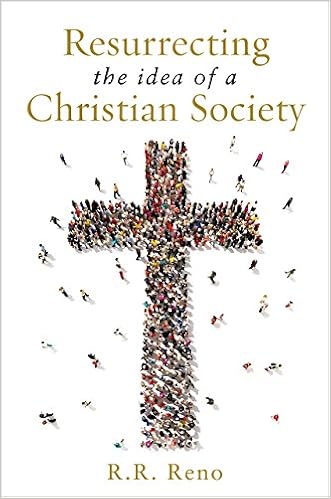
Resurrecting the Idea of a Christian Society

by R. R. Reno


Dear Readers,

Over the last few years, I've been making a case for a strong Christian witness in today's society. From the beginning of my time as editor of First Things, I've argued that progressivism represents a war on the weak. And I've argued that social and religious conservatism, rather than progressivism, is what best serves the poor and disadvantaged. It promotes solidarity and strengthens our commitment to serve the good of our neighbor.

In Resurrecting the Idea of a Christian Society, my new book appearing on August 1, I draw these strands together into a sustained argument for a Christian vision of moral and social renewal.

I know, it seems like a pipe dream. So much is going against us these days. But the decline of marriage, rising drug addiction, suicide, and a general pessimism about the future indicate that there's a hollowness at the center of today's secular establishment. Which means that men and women of faith have a real opportunity to fill the void. Religious communities remain powerful sources for moral formation and communal renewal. I don't imagine a return to an earlier era. But I argue that you and I can better serve our fellow citizens if we offer a clear analysis of today's problems—and a confident Christian vision of the future.

You can preorder now.

Thanks for being loyal readers of First Things.

Yours,

R. R. Reno


Review from: www.amazon.com: 


  • America’s two greatest strengths—her liberal democratic culture and her free-market economy—have made her a global superpower. 
  • But left unchecked, these two strengths can become great cultural weaknesses, sowing selfishness, recklessness, and apathy. 
  • In Resurrecting the Idea of a Christian Society, theologian R. R. Reno argues that America needs a renewal of Christian ideals—ideals that encourage self-sacrifice, responsibility, and solidarity. 
  • Drawing on T.S. Eliot’s 1940 essay “The Idea of a Christian Society,” Reno shows how Christianity encourages “an abiding ambition for higher things” and a “moral vision” that can strengthen communities and transform America into a truly great nation.

Cardinal Sarah reflects on new feast of Saint Mary Magdalene


The first liturgical feast of Saint Mary Magdalene


Witness of Divine Mercy

by Cardinal Robert Sarah

On July 22, by the decision of Pope Francis and in the Year of Mercy, we celebrate St. Mary Magdalene as a liturgical feast. The new preface, entitled De apostolorum apostola (“apostle of the apostles”), following Rabanus Mauro and Saint Thomas Aquinas, presents the beloved saint of the Lord as the testis divinae misericordiae (“witness of divine mercy”), the first messenger who announced the Lord’s Resurrection to the apostles (cf. John Paul II, Mulieris dignitatem, n. 16). I wish to reflect on two attitudes of the saint which are the heart of the new preface and the texts of the Mass, and which can help all Christians, men and women, to deepen our commitment as followers of Christ: adoration and mission.

The new preface presents the Magdalene, who passionately loved Christ while he was alive, saw him dying on the Cross, sought him as he lay in the tomb, and was the first to adore him newly risen from the dead. The text then highlights that the saint, honored with the mission of being an apostle of the apostles, announces the good news of the living Christ to the apostles who in turn would spread this news to the ends of the earth.

Love is what characterizes the life of Mary Magdalene. Passionate love, as the two possible readings of the Mass recall: “I sought him whom my soul loves; I sought him but found him not. I will rise now and go about the city, in the streets and in the squares; I will seek him whom my soul loves” (Song of Songs 3:1-2), for “the love of Christ possesses us” (2 Corinthians 5:14). A love that leads to seeking the Lord, as the responsorial psalm and the preface of the feast sing: “O God, thou art my God, at dawn I seek thee, my soul thirsts for thee; my flesh faints for thee, as in a dry and weary land where no water is” (Psalm 63:2). Therefore, dilexerat viventem e quaesierat in sepulcro iacentem (“she had loved him while he was alive” and “sought him as he lay in the tomb”). Indeed, “she came to the tomb early, while it was still dark” (John 20:1).

It is love which must characterize our lives as Christians, as true friends of Jesus. A love that leads to seek the Lord. This is the only valid program for the Church, as John Paul II reminded us: “The program already exists: it is the plan found in the Gospel and in the living Tradition, it is the same as ever. Ultimately, it has its center in Christ himself, who is to be known, loved and imitated, so that in him we may live the life of the Trinity, and with him transform history until its fulfilment in the heavenly Jerusalem. This is a program which does not change with shifts of times and cultures, even though it takes account of time and culture for the sake of true dialogue and effective communication. This program for all times is our program for the Third Millennium (Novo millenio ineunte, n. 29).

To seek Christ in order to love him, as Mary Magdalene did. Pope Francis’s words help us in this, when he tells us: “How good it is to stand before a crucifix, or on our knees before the Blessed Sacrament, and simply to be in his presence! How much good it does us when he once more touches our lives and impels us to share his new life! What then happens is that ‘we speak of what we have seen and heard” (1 Jn 1:3).’” (Evangelii gaudium, n. 264). To seek Christ in order to love him and give him to others. This is the program for the Church and for each of her children.

St. Mary Magdalene seeks the Lord, and when she finds him, she adores him. She is the first to adore the Lord, as the preface sings: quaesierat in sepulcro iacentem, ac prima adoraverat a mortuis resurgentem [she sought him as he lay in the tomb, and was the first to adore him newly risen from the dead].

Adoration takes first place. Mary Magdalene reminds us of the need to recover the primacy of God and the primacy of adoration in the life of the Church and in the liturgical celebration. This was a fundamental goal of the Second Vatican Council and continues to be so now. God must occupy the first place, but this cannot be taken for granted. John Paul II, on the 25th anniversary of Sacrosanctum Concilium, recalled: “Nothing of what we do in the Liturgy can appear more important than what in an unseen but real manner Christ accomplishes by the power of his Spirit. A faith alive in charity, adoration, praise of the Father and silent contemplation will always be the prime objective of liturgical and pastoral care.” (Vicesimus Quintus Annus, n. 10).

To adore God, as the Bishop of Rome states, in “every liturgical ceremony”; “what is most important is adoration” and not “the songs and rites,” as beautiful as they are: “The whole community together looks at the altar where the sacrifice is celebrated and adores. But I believe, I say it humbly, that perhaps we Christians have lost somewhat the sense of adoration. Let us consider: we go to the temple, we gather as brethren, and it is good, it is beautiful. But the center is where God is. And we adore God” (November 22, 2013). The pope asks us: “You, I, do we worship the Lord? Do we turn to God only to ask him for things, to thank him, or do we also turn to him to adore him? What does it mean, then, to adore God? It means learning to be with him, to stop to talk with him, sensing that his presence is the truest, the best, the most important thing of all.” (April 14, 2013).

Half a century after Sacrosanctum Concilium, the pope reminds us of the need to put God first: “To get diverted by many secondary or superfluous things does not help; what helps is to focus on the fundamental reality, which is the encounter with Christ, with his mercy and with his love, and to love our brothers and sisters as he has loved us. An encounter with Christ is also adoration, a little used word: to adore Christ.” (October 14, 2013).

.............


Lieu central du pouvoir, le Grand Palais du Kremlin fascine


Les intérieurs cachés du Grand Palais du Kremlin


Le Grand Palais du Kremlin abrite l’administration présidentielle, mais aussi des salles de réception, témoignages de l’histoire russe. 

L’ensemble de 25 000 m² comprend le Palais du XIXe siècle, qui a absorbé les anciens édifices : le Palais à Facettes et le Vestibule Sacré (XVe siècle), la Chambre d’Or de la Tsarine (XVIe), le Palais des Térems (XVIIe) et leurs églises. 

Ses décors somptueux ont été restaurés et réaménagés comme à l’origine.

Lire la suite: fr.rbth.com