Translate

viernes, 30 de octubre de 2015

Cameron: the last of the Blairites...


The neo-Georgian Prime Minister


BY JOHN GRAY


By the time he stands down, David Cameron's Britain will be neo-Georgian – a country that is, in effect, governed by a coterie of wealthy families competing for power.
What is emerging isn’t exactly Thatcherite, or neoliberal. Instead, it is a variety of mercantilism, with government not retreating from the marketplace but actively reshaping it so that it better serves the interests of trade and wealth accumulation.
An endearing story has it that when the aged Stanley Baldwin was asked at a meeting which ideas had influenced him, he replied – much to everyone’s surprise – that his view of politics had been shaped by the Victorian jurist Henry Maine. Baldwin, who had been prime minister three times and had dominated British politics during the interwar years, was not known for having a strong interest in political philosophy. Yet he took from Maine, he said, a belief that guided him through his political life. From a system founded on hierarchy and command, governance was moving towards one based on agreement and consent; society was advancing from status to contract. At this point, Baldwin paused, seemingly deep in thought: “Or was it the other way round?”

A much subtler figure than he liked to appear, Baldwin was most likely pulling his audience’s leg. It is not easy to imagine David Cameron displaying any such self-deprecating wit. Anthony Seldon and Peter Snowdon begin and end Cameron at 10(William Collins), their recent account of the Prime Minister’s first five years in power, by asking whether he “has claim to be considered the 21st-century Baldwin”. But the differences between the two are more instructive than any similarities there may be.

Like Baldwin, who knew how to use the power of radio to craft an image of himself as a rather ordinary person who just happened to be prime minister, Cameron has lodged himself in voters’ minds as someone who, despite his privileged background, understands their everyday concerns. Yet there can be few who view him as having Baldwin’s reliably sound judgement. A prime minister who almost triggered the break-up of the United Kingdom with his slapdash management of the Scottish independence referendum and became the first head of a British government since 1782 to be defeated in the Commons on a matter of war (when he lost the vote to take military action in Syria in 2013) does not leave an impression of being a steady hand on the tiller.

While Baldwin’s bluff exterior concealed a sceptical intelligence, there is no reason to suppose that Cameron is anything other than he appears to be – impressively quick on the uptake but, in essence, unthinking. This may be why he has been such a successful practitioner of the Blairite politics of perception management. If there were anything hidden beneath Cameron’s changing appearances, the successive faces he has projected into the world could have looked inauthentic.

These shifts are in character. From urging greater understanding of young offenders in 2006 – a stance mocked as urging people to “hug a hoodie” – he shifted to bewailing “broken Britain” in the run-up to the 2010 general election. Having presented an image of himself as a green crusader, he appointed a climate-change sceptic, Owen Paterson, as environment secretary in 2012. Around the same time, according to Call Me Dave (Biteback), Michael Ashcroft’s and Isabel Oakeshott’s much-discussed unauthorised biography, Cameron protested, during an internal debate about whether British farmers should do more conservation work in return for EU subsidies: “Why should we be the only saint in the brothel?” Soon after the election in May this year, he began dismantling renewable energy subsidies.Such turns are the stuff of politics. But Cameron carries them off with exceptional ease and the reason for this is not that he is unusually skilful in duplicity. Instead, the figure that emerges from these two, quite different, but in some ways equally revealing books is of someone who does not need to dissemble because there is nothing beneath the surface. More than Tony Blair, whose ability to read the public mood was accompanied by a streak of messianic zeal that eventually destroyed him, Cameron is an archetypal embodiment of the hypermodern leader – prophetically anticipated by the Austrian novelist Robert Musil in The Man Without Qualities (1930-43) – who succeeds by going nowhere. Cameron is a devoted moderniser who sees himself as a force for progress. Yet he has no particular destination or direction in mind and moves on easily from accidents that have derailed others. The stench of Iraq will surround Blair for the rest of his days. In contrast, Cameron has left behind his ruinous adventure in Libya with barely a stain on him.


.....


Read more: www.newstatesman.com


L’actualité montre les failles de la laïcité actuelle: l’AED organise vendredi 6 novembre son colloque annuel: une réflexion primordiale pour la France.


J-8 COLLOQUE : « quelle laïcité voulons-nous pour demain? »


J-8: L’AED organise vendredi 6 novembre son colloque annuel intitulé: « Quelle laïcité voulons-nous pour demain? » Des intervenants d’exception nous aiderons à réfléchir et à étudier les laïcités d’autres pays pour élaborer ensemble des propositions qui seront envoyés au gouvernement.
Pour s’inscrire, cliquer ici


Pourquoi l’AED organise un colloque sur la laïcité ?


« Depuis des mois, l’actualité montre les failles de la laïcité actuelle (attentat à Charlie Hebdo, polémique sur l’affiche de la RATP, montée de l’extrémisme et de l’intolérance religieuse, multiplication des revendications communautaristes, augmentation des actes de profanation, …). Une laïcité de plus en plus mal ajustée à notre environnement qui évolue. Il y a donc urgence à réfléchir sur le sujet d’autant que la tentation existe pour la République de nier ou totalement privatiser le fait religieux pour échapper à cette crispation.» Marc Fromager, directeur de l’AED.

Forte de son expertise dans 150 pays et de son rapport bisannuel sur la liberté religieuse dans le monde, l’AED considère que cette réflexion est primordiale pour la France.

Ce colloque fera intervenir un ensemble de spécialistes (Ghaleb Bencheikh, Jean-François Chemain, Xavier Lemoine, Ysé Tardan-Masquelier, Jean-Luc Marion, Gregor Puppinck…), gage de la qualité des échanges qui s’y dérouleront. 

Mais il y aura également un aspect participatif : 

1/ le public sera invité à être acteur dans la réflexion (par une fiche à remplir en fin de colloque) 

2/ à la suite du colloque, l’AED rédigera une synthèse qu’elle enverra aux représentants politiques et aux acteurs religieux de France.

Programme (cliquez ici pour avoir le programme détaillé)

Dans une première partie, il s’agira de faire un état des lieux de la laïcité en France, de voir les causes profondes des dérives actuelles en abordant, notamment, l’angle philosophique et politique. Nous souhaitons apporter ensuite une ouverture sur le monde en mettant en avant quelques exemples de laïcités vécues autrement dans des pays tels que le Liban, la Bosnie-Herzégovine, la Turquie, l’Inde…puis dans une troisième partie, nous souhaitons arriver à des propositions concrètes pour la France.

Intervenants:
  • Ghaleb Bencheikh, philosophe et théologien musulman, président de la Conférence mondiale des religions pour la paix
  • Jean-François Chemain, écrivain, diplômé de Sciences po Paris, agrégé et docteur en Histoire
  • Christophe Grannec, chercheur au CNRS, sociologue des religions
  • Xavier Lemoine, maire de Montfermeil
  • Jean-Luc Marion, philosophe et académicien français
  • Pierre Marsollier, délégué général de l’Enseignement catholique
  • Gregor Puppinck, docteur en droit, directeur du Centre européen pour le droit et la justice
  • Père Stalla Bourdillon, directeur du Service Pastoral d’Etudes Politiques – Aumônier des parlementaires
  • Ysé Tardan-Masquelier, historienne des religions, chargée de cours sur la laïcité à l’ICP
  • Père Michel Viot, prêtre du diocèse de Blois
Inscriptions: Sur le site: www.aed-france.org en cliquant sur ce lien, ou par mail: contact@aed-france.org Tarif du billet: 20 euros (tarif étudiant à 15 euros)

Lieu: (vendredi 6 novembre de 9h à 18h) Amphithéâtre de l’ASIEM – 6, rue Albert de Lapparent – 75 007 Paris – Métro Ségur Pour toutes questions: par mail: contact@aed-france.org ou par téléphone: 01.39.17.30.10

www.aed-france.org/

jueves, 29 de octubre de 2015

This book provides new context for evaluating Pope Pius XII


A Black Legend Refuted


by Fr. John Jay Hughes


Mark Riebling's "Church of Spies: The Pope’s Secret War Against Hitler" is a beautifully written book which not only defends Pius XII but utterly demolishes the Black Legend in intricate and meticulously documented detail


Of the eight Popes who shepherded the Church from 1903 to century’s end, none is so hotly disputed as Pius XII, who reigned from March 2nd, 1939 until his death on October 9th, 1958. At issue is the Pope’s alleged “silence” in the face of the Holocaust. His defenders point out that in reality he was not silent. At the start of World War II Pius authorized Vatican radio to broadcast reports of Nazi atrocities in Poland. These ceased only at the urgent plea of victims reporting that the broadcasts intensified their sufferings.

In 1942 the Pope’s Christmas message spoke of “the hundreds of thousands who, through no fault of their own, and solely because of their nationality and race, have been condemned to death or progressive extinction.” Dismissed by his latter day critics as too vague to be understood, the Pope’s words were well understood by the Nazis, who called them “one long attack on everything we stand for. Here he is clearly speaking on behalf of the Jews ... and makes himself the mouthpiece of the Jewish war criminal.” The New York Times also understood, commenting: “This Christmas more than ever [Pope Pius XII] is a lonely voice crying out of the silence of a continent.”

At the war’s end Golda Meier (later Israel’s Prime Minister), Albert Einstein, the World Jewish Congress, the American Jewish Committee and many other Jewish voices applauded Pius for doing what he could to rescue Jews: by providing life saving travel documents, religious disguises, and safekeeping in cloistered monasteries and convents, including the Pope’s own summer residence at Castel Gandolfo, where Jewish babies were born in the Pope’s own bedroom. The Israeli diplomat and scholar Pinchas Lapide commented: “No Pope in history has been thanked more heartily by Jews.” At the Pope’s death in October 1958 the New York Times took three days to print tributes to Pius from New York City rabbis alone.

The chorus of praise fell silent overnight in 1963 with the publication of a pseudo-historical stage play, The Deputy, by a former junior member of the Hitler Youth, Rolf Hochhuth. The play’s scathing indictment portrayed Pius XII as a cold-hearted cynic, more interested in the Vatican’s investment portfolio than in Hitler’s slaughter of European Jews, including those rounded up in Rome under the Pope’s own windows. The play’s message is well conveyed by its final line, in which the German ambassador to the Holy See, Ernst von Weisäcker, telegraphs his superiors in Berlin: "Since further action on the Jewish problem is probably not to be expected here in Rome, it may be assumed that this question, so troublesome to German-Vatican relations, has been disposed of.”

Seldom can a work of fiction have appeared at a time more favorable to its message. The 1960s saw publications by liberal theologians proclaiming “the death of God.” It was also the age of the Youth Revolution, with the slogan, “Don’t trust anyone over 30.” A play which purported to unmask one of the world’s leading moral authorities was a godsend to the propagators of these new and exciting ideas.

The bureaucratically organized slaughter of six million Jews was an event so horrible that many people found it difficult to believe that ultimate responsibility belonged to a single individual, Adolf Hitler. Hochhuth helped them come to terms with the inconceivable by assigning co-responsibility to the one man who (Hochhuth’s Black Legend alleged) could have stopped the machinery of death, had he wished to do so: the Pope of Rome. Millions who had never experienced the reign of terror imposed on Europe by the Nazis during World War II, with a totally controlled press and media, and people sent to concentration camps (which often meant death) simply for listening to news reports on British radio, welcomed Hochhuth’s indictment as an aid to understanding an event beyond the limits of what was previously considered possible.

From 1963 onward Hochhuth’s Black Legend has reigned supreme. Accepted by all but a minority of historical scholars, and propagated without reserve by the media, it is still alive and well today. A book published in May of this year, The Pope’s Dilemma by the retired Toronto professor, Jacques Kornberg, accuses Pius XII of “moral failure” for concentrating exclusively during World War II on Church interests, without regard for extra-ecclesial events and concerns.

Comes now Church of Spies: The Pope’s Secret War Against Hitler by Mark Riebling, a blockbuster of a book which not only defends Pius XII (which others have undertaken with varying success) but utterly demolishes the Black Legend by showing in intricate and meticulously documented detail (107 pages of end notes and sources) that from the very start of the war the Pope cooperated secretly with anti-Nazi forces in Hitler’s thousand year Reich who sought, first, to remove the Führer from power; and when that failed, to kill him.

Appalled by reports of Nazi atrocities in Poland during the first month of occupation – hundreds of priests shot, systematic extermination of Jews forced to dig their own burial trenches, then stripped naked and machine-gunned like sardines in a can; “and in one photo, a police officer shooting a child clamped between his knees” – Pius made up his mind. “He would engage the German military resistance and encourage a military counterrevolution. He would serve as secret foreign agent for the resistance – presenting and guaranteeing its plans to the British. He would partner with the [German] generals not just to stop the war, but to eliminate Nazism by removing Hitler.”

The Pope’s aides were stunned. The highly respected British historian, Owen Chadwick wrote later: “Never before had a Pope engaged so delicately in a conspiracy to overthrow a tyrant by force.” The Pope, his co-workers thought, was going too far. Were Hitler to learn of the pontiff’s role, Hitler would take terrible revenge on Catholics, invade the Vatican, and kidnap the Pope. Later in the war Hitler actually ordered both the invasion and kidnapping, only to be frustrated by his generals’ foot-dragging. 

Central in this complicated and ever shifting story is the devout and heroically courageous German Catholic layman, Josef Müller, described by Riebling as “a big-eared Bavarian book publisher, who puffed a pipe and collected stamps.” We first encounter him on page 2 of the book, standing on April 8th, 1945, beneath a Nazi gallows, just minutes from execution. Only on the book’s final page do we learn how he was saved from this gruesome fate (he died in 1979): through an eleventh-hour phone call from the SS officer Walter Huppenkothen, commander of Hitler’s security guard, yet another secret anti-Nazi, whom Müller had befriended years previously. Müller worked throughout the war with Admiral Canaris, Chief of Hitler’s counter-intelligence network, and his cavalry officer assistant, Colonel Hans Oster. Like a number of those who served Hitler, both men were secret but determined anti-Nazis. All but Müller were executed by the Nazis just before the war’s end.

Müller was also an airplane pilot. He is estimated to have flown a tiny light plane over the Alps to Merano in northern Italy some 150 times during war with permission of the government he was trying to destroy, carrying communications for the Pope from Hitler’s clandestine enemies. Müller also accompanied the well known German Protestant Pastor Dietrich Bonhoeffer to Rome, where the latter met with papal aides in the crypt of St. Peter’s Basilica.

Another Protestant who worked with Hitler’s secret enemies was Count Helmut Moltke, called by the American diplomat George Kennan, “the greatest person, morally, and the largest and most enlightened in his concepts that I met on either side of the battle-lines in the Second World War.” Like Canaris and Oster, Moltke held a strategic governmental position in Hitler’s Third Reich, blocking the worst when he could, and paying with his life at the end of the war for his efforts. On the Pentecost weekend of May 22-25, 1942 Moltke hosted a meeting of some twenty people at his east German estate “Kreisau” (the “Kreisau Circle”) to discuss the building of a new “Decent Germany” after the war. Pius XII had helped plan the agenda, and was told about the discussion afterwards.

Riebling’s book is beautifully written, and reads like a novel. It makes severe demands on the reader nonetheless – due to the large cast of characters, and the fact that almost all of them are engaged in secret deception. Most had code names. Pius XII was “the Chief.”

Especially moving is Riebling’s account of Josef Müller’s private meeting with Pius XII, at the Pope’s request, on June 1st, 1945, just three weeks after the war’s end in Europe. “I had hardly crossed the threshold of his study,” Müller wrote, “when the Holy Father approached me, and embraced me.” He could hardly grasp how Müller had escaped. He felt as if his own son had returned from terrible danger.

The Pope put his arm around Müller’s shoulder and seated his guest next to him at a long table, but close, so that they could hold hands. “Pius XII has often been accused of being a proud and detached Roman” Müller wrote afterward, “I saw nothing of that during my audience. … I told Pius of my plans to fashion a new bloc [in Germany] from strong Christians, regardless of denomination, in order to confront collectivism [i.e. Communism]. That he agreed with this idea brought me great joy.”

It remains to pay tribute to Riebling’s publisher. The book’s dust jacket, and the volume itself, are both completely black, save for a silvery partial sketch on the jacket of a sinister looking figure in an over-sized miter, his right hand raised in blessing. It is impossible to overlook this visual reminder of the long flourishing Black Legend which Riebling so successfully demolishes in these riveting pages.

Church of Spies: The Pope’s Secret War Against Hitler
by Mark Riebling
Basic Books, New York, 2015
375 pages, $29.99.


Read more: www.catholicworldreport.com

El vaticanista George Weigel ha publicado un artículo respondiendo a la interpretación de que los divorciados vueltos a casar por lo civil puedan comulgar


George Weigel denuncia que el episcopado alemán está malinterpretando la Relación del sínodo

Fuente: www.religionenlibertad.com


La Relación final del sínodo ha dado lugar a controversia, sobre todo en torno a los puntos 84 a 86, que suscitaron un rechazo cercano a una tercera parte de los padres sinodales. Desde el episcopado alemán se ha sugerido que recogen en lo sustancial la pretensión del cardenal Walter Kasper de que los divorciados vueltos a casar por lo civil puedan comulgar.

En respuesta a esa interpretación, el vaticanista George Weigel ha publicado un artículo que, por su interés, reproducimos a continuación. Lo ofrecemos en la traducción de Enrique Treviño para Infocatólica, tomado del original inglés.

La locomotora alemana del sesgo informativo, a toda marcha 

A escasos noventa minutos de cantar el Te Deum, y la clausura del último día de trabajo del Sínodo-2015, se inició la controversia acerca del sentido de los tres párrafos del documento final que recibieron el mayor número de votos negativos de los padres pero menos de un tercio de los mismos, el mínimo para ser excluidos del texto final.

Una vez que estos párrafos fueron considerados por los padres del Sínodo, la noche del jueves, se propusieron varias decenas de enmiendas al borrador del documento final. Muchas de estas propuestas sugerían eliminar uno, dos o los tres párrafos en entredicho debido a ambigüedades percibidas en su redacción. Se hicieron aproximadamente veinte sugerencias similares el viernes por la mañana durante el debate de la asamblea general del primer borrador del documento final. Estas propuestas fueron rechazadas por el comité de redacción, mas se insertó un detalle crucial en el texto. Hablaremos más sobre esto en seguida.

He aquí mi traducción, de los tres párrafos controvertidos, tomada del original italiano tal y como lo divulgó la Oficina de Prensa de la Santa Sede.

84. Los bautizados que se han divorciado y vuelto a casar por lo civil deben ser integrados en las comunidades cristianas en las diversas modalidades posibles, evitando toda ocasión de escándalo. La lógica de la integración es la clave de su acompañamiento pastoral, para que sepan no solo que pertenecen al Cuerpo de Cristo, que es la Iglesia, sino para que puedan tener una feliz y fecunda experiencia en ella. Han sido bautizados, son hermanos y hermanas, los dones y carismas del Espíritu Santo fluyen por ellos para el bien de todos. Su participación puede expresarse en diversos servicios eclesiales; es necesario, por lo tanto, discernir cuáles de las diversas formas de exclusión actualmente practicadas en el ámbito litúrgico, pastoral, educativo e institucional pueden ser superadas. No deben sentir únicamente que no están excomulgados, sino también vivir y madurar como miembros vivos de la Iglesia, experimentándola como una madre que los acoge siempre, los cuida con afecto y los alienta en el camino de la vida y del Evangelio.

Esta integración es también necesaria para el cuidado y la educación cristiana de sus hijos, lo cual es la consideración más importante. Para la comunidad cristiana cuidar de estas personas no es debilitar nuestra fe y su testimonio acerca de la indisolubilidad matrimonial, sino que mediante este cuidado la Iglesia está expresando su propia caridad.

85. San Juan Pablo II ha ofrecido un criterio integral que ha permanecido como la base para la valoración de estas situaciones: «Los pastores, por amor a la verdad, están obligados a discernir bien las situaciones. En efecto, hay diferencia entre los que sinceramente se han esforzado por salvar el primer matrimonio y han sido abandonados del todo injustamente, y los que por culpa grave han destruido un matrimonio canónicamente válido. Finalmente están los que han contraído una segunda unión en vista a la educación de los hijos, y a veces están subjetivamente seguros en conciencia de que el precedente matrimonio, irreparablemente destruido, no había sido nunca válido» [Familiaris Consortio 84]. Es entonces tarea de los presbíteros acompañar a las personas interesadas en el camino del discernimiento según la enseñanza de la Iglesia y las orientaciones del Obispo. En este proceso será útil hacer un examen de conciencia, a través de momentos de reflexión y arrepentimiento. Los divorciados vueltos a casar deberían preguntarse cómo se han comportado con sus hijos cuando la unión conyugal entró en crisis, si hubo intentos de reconciliación, cómo está la situación del compañero abandonado, qué consecuencia tiene la nueva relación sobre el resto de la familia y la comunidad de fieles, qué ejemplo ofrece a los jóvenes que se deben preparar para el matrimonio. Una sincera reflexión puede reforzar la confianza en la misericordia de Dios que no se le niega a ninguno.

Además, no se pueden negar que en algunas circunstancias «la imputabilidad y la responsabilidad de una acción pueden quedar disminuidas e incluso suprimidas» (CCC, 1735) a causa de diversas condiciones. Como consecuencia, el juicio sobre una situación objetiva no debe llevar a un juicio sobre la «imputabilidad subjetiva» (Pontificio Consejo para los Textos Legislativos, Declaración del 24 de junio de 2000, 2a).

En determinadas circunstancias a las personas se les dificulta sobremanera actuar de un modo distinto. Por ello, mientras sostenemos una norma general, es necesario reconocer que la responsabilidad respecto a determinadas acciones o decisiones no es la misma en todos los casos. El discernimiento pastoral, que tiene en cuenta la conciencia correctamente formada en la persona, debe a la vez prevenir estas situaciones. Las consecuencias de una acción no es la mismas necesariamente en todos los casos.

86. El proceso de acompañamiento y discernimiento orienta a estos fieles a un examen de conciencia acerca de su situación ante Dios. El coloquio con el sacerdote acerca del fuero interno contribuye a la formación de un juicio correcto sobre lo que obstaculiza la posibilidad de una participación más plena en la vida de la Iglesia y sobre los pasos que pueden favorecerla y hacerla crecer. Dado que en la misma ley no hay gradación (FC, 34), este discernimiento no podrá jamás prescindir de las exigencias de la verdad y la caridad del Evangelio propuesta por la Iglesia. Para que esto suceda, deben garantizarse las condiciones necesarias de humildad, discreción, amor a la Iglesia y a sus enseñanzas, en la búsqueda sincera de la voluntad de Dios y en el deseo de responder de una manera más perfecta a esta.


Algunas notas exegéticas:

-La posibilidad de acceder a la Sagrada Comunión por los divorciados y vueltos a casar por lo civil no se menciona en estos párrafos o en el texto final en absoluto.

-La frase subrayada en el párrafo 85 más arriba (que es un énfasis añadido) se insertó en el texto final ya redactado, después de que el párrafo fue criticado por los padres sinodales, para ratificar que las enseñanzas de la Iglesia en cuanto a la indisolubilidad del matrimonio y el merecimiento para recibir la Sagrada Comunión sigue siendo el fundamento desde el cual el "acompañamiento pastoral" y el "discernimiento" se llevan a cabo. La construcción completa de la oración deja en claro, o debería hacerlo, que la guía pastoral del obispo (y por extensión la de los sacerdotes) debe corresponder a la norma de las enseñanzas establecidas.

-Las enseñanzas de Juan Pablo II en Familiaris Consortio 84 son el "criterio integral" operante en esta difícil y delicada situación pastoral. Se propuso en varios modi(enmiendas) presentadas la mañana del viernes que la sección 84 de Familiaris Consortiose citara en su totalidad en el texto final del Sínodo; de haberse aceptado, esas enmiendas hubieran evitado ambigüedades. Mas, si Familiaris Consortio 84 es efectivamente el "criterio integral" para el discernimiento pastoral y espiritual, el aspecto integral ciertamente parece incluir lo siguiente (que aparece cuatro oraciones más abajo de el material citado aquí con respecto al párrafo 85): "La Iglesia, no obstante, fundándose en la Sagrada Escritura reafirma su práxis de no admitir a la comunión eucarística a los divorciados que se casan otra vez. Son ellos los que no pueden ser admitidos, dado que su estado y situación de vida contradicen objetivamente la unión de amor entre Cristo y la Iglesia, significada y actualizada en la Eucaristía. Hay además otro motivo pastoral: si se admitieran estas personas a la Eucaristía, los fieles serían inducidos a error y confusión acerca de la doctrina de la Iglesia sobre la indisolubilidad del matrimonio".

-Ni en estos párrafos ni en el texto final existe sugerencia alguna indicando que la "doctrina" se puede separar de la "práctica" en cuanto al merecimiento de los divorciados y vueltos a casar para recibir la Sagrada Comunión.

-La propuesta de Kasper no aparece en estos tres párrafos o en el texto final ya que fue rechazada de manera contund‪ente por los padres del Sínodo.

-El texto final no apoya el "catolicismo de opción local", i. e., la cesión de la autoridad sobre estos asuntos a las conferencias regionales o nacionales de obispos, o a obispos y pastores locales.

-El texto final deja en claro que la "conciencia", correctamente comprendida, es una conciencia debidamente informada, formada en y por medio de la verdad; lo cual quiere decir que "conciencia" no es simplemente la voluntad expresada por la persona. Las declaraciones acerca de la conciencia en los párrafos 85 a 86 del texto final deben entenderse a la luz de esta afirmación.

Todo esto indica que las afirmaciones de los obispos alemanes, repetidas por los medios a través del mundo, al tenor de que estos tres párrafos son una reivindicación tacita de las propuestas kasperianas, en sus varias manifestaciones –comunión a los divorciados vueltos a casar mediante un «camino de penitencia», cesión de la autoridad sobre el asunto a las conferencias episcopales, un llamado al derecho de "conciencia"– no son capaces de resistir un escrutinio serio. Informes de los medios al efecto de que estos tres párrafos apoyan la comunión para los divorciados vueltos a casar se basan en la ignorancia del texto o a una vulnerabilidad a la máquina de sesgo publicitario alemán.


El lenguaje de los párrafos es a veces ambiguo, especialmente si va uno en busca de ambigüedades. Sin embargo, si se leen a través del prisma "integral" deFamiliaris Consortio 84 en su totalidad, estos tres párrafos –con su bienvenida y tierna determinación de tender la mano a los divorciados y vueltos a casar– no son tan solo compatibles con la doctrina y la disciplina sacramental clásica de la Iglesia Católica, sino que la refuerzan al declarar con sencillez que las enseñanzas son el fundamento desde el cual se realiza el acompañamiento pastoral.

Why Italy could soon be Europe's fastest growing economy


Could Europe’s next growth locomotive be Made in Italy?


BY: ALESSIO TERZI

Important reforms put in place over the past months mean that Italy could indeed become the fastest growing large economy in the euro area in a not-too-distant future, writes Alessio Terzi at Bruegel. A substantial liberalisation of the labour market – embodied in the so-called ‘Jobs Act’ – could boost Italy’s appallingly low employment rate by as much as 10 percentage points over the long term according to the Forum Ambrosetti


Important reforms put in place over the past months, combined with a conjunction of particularly supportive external factors, mean that Italy could indeed become the fastest growing large economy in the euro area in a not-too-distant future.

“I bet you that in the next 10 years, Italy will return to be the [economic] leader of Europe, the locomotive of Europe.” When reading these words onTIME magazine in late April 2014, many must have thought that Italy’s then new Prime Minister Matteo Renzi was at best youthfully delusional, at worst a dazzling propagandist.

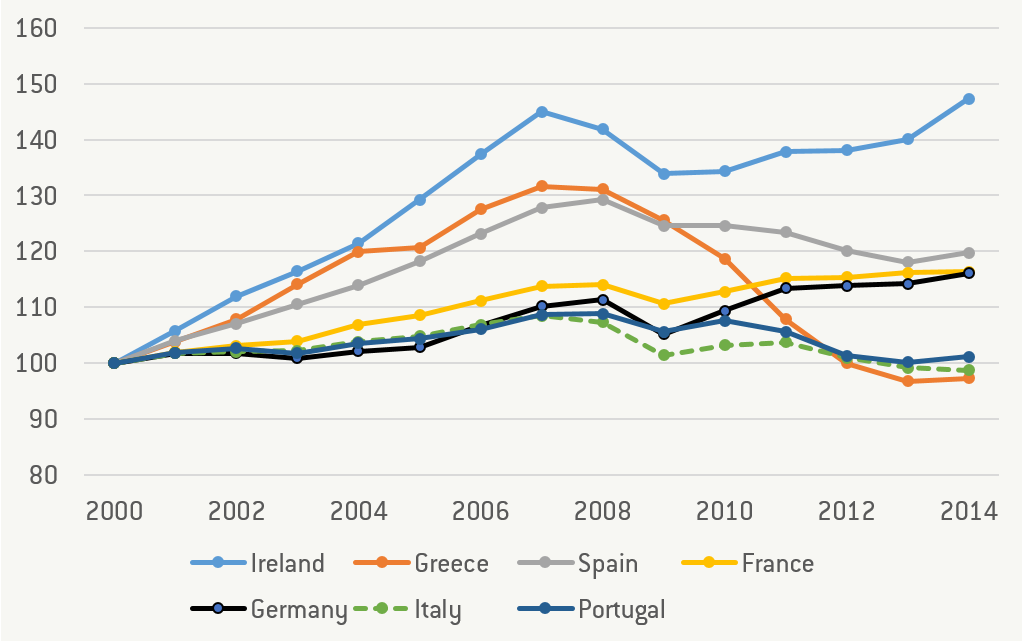
Scepticism was all but unwarranted for a country that, over the past decades, had proved serially impossible to reform and, as a consequence, is the only EU member state, together with Greece, where real GDP is now below its 2000 level.

However, one and a half years down the road, the Prime Minister’s optimistic view for Italy starts no longer looking like a completely far-fetched scenario, but rather as a possibility. Important reforms put in place over the past months, combined with a conjunction of particularly supportive external factors, mean that Italy could indeed become the fastest growing large economy in the euro area in a not-too-distant future.

Figure 1. Real GDP (2000=100)


Source: Eurostat

Notwithstanding a wafer-thin majority in Parliament, Renzi has managed to secure approval for reforms that have the potential to restructure deeply the Italian economy.

A substantial liberalisation of the labour market – embodied in the so-called ‘Jobs Act’ – could boost Italy’s appallingly low employment rate by as much as 10 percentage points over the long term according to a survey of business leaders attending the Forum Ambrosetti, and reverse the decline in labour productivity observed during the 2000s.

................


The Paragon Initiative: what the core business of central government should be, AND how these core functions should be managed ...


How to achieve effective government


Executive summary

The UK’s current model of government is failing and unsustainable.

Over the past 150 years, politicians have taken over many aspects of our lives that were previously the responsibility of families, civil society and local government, and centralised them in the hands of a small number of ministers and civil servants.


This huge growth in government has been associated with demonstrably poor outcomes and public services, often falling behind international best practice:

• In managing the public finances politicians have run deficits in 52 of the last 60 years; the official national debt (at £80,000 per family) is historically unprecedented after a long period of peace and the state has made huge future commitments in unfunded health and pension liabilities

• In health the UK ranks 20th out of 24 OECD countries on cancer survival rates and 24th out of 30 countries on the ‘efficiency’ of the health system

• In education 40 per cent of pupils do not get the accepted minimum standard of GCSE grades A* to C in English and Maths by age 16. More shockingly, 90 per cent of those who don’t reach this basic standard by 16 don’t achieve it by age 19

• In social outcomes there are 3.3 million UK households with at least one member aged 16 to 64 where no-one is currently working. This equates to 6 million people living in workless households (4.5 million people of working age and 1.5 million children)

• In regulating the economy politicians have raised costs and restricted opportunity. Land use planning regulations, for example, have raised house prices by as much as 40 per cent above what they would be under a more liberal regime

• In political terms there is now widespread disillusionment with the current model of government. In May 2014, a ComRes poll posed the question: “Do you trust government?” 20% said they did, whilst 9% didn’t know. An overwhelming 71% said they didn’t trust government

The most important reasons for these failures of central government are: complexity, over-centralisation, monopoly and bad management. Together these have taken power away from end users of services – making government unresponsive to the wants and needs of individuals and inflexible to changing technologies and demography.


Achieving effective government to meet the challenges of today and the future therefore requires politicians to be bold enough to completely re-think the scope of the state and how its functions are delivered and managed.

The Paragon Initiative is a major new five-year project. It will be the largest body of research ever undertaken by the IEA.

The aim is to assess in detail the current problems we face across all major government functions. It will be highly critical of the performance of government, because unless politicians acknowledge the poor outcomes and understand their underlying causes, no action will be taken to deliver the significant changes required.

The Initiative will determine the fundamental reforms that are needed to the way we are governed to solve these problems, and produce a roadmap towards a world where people have more control over their own lives and politicians are able to concentrate more effectively on the core functions of government.

The end point will be a series of research papers which, taken together, will outline:

• what the core business of central government should be;
• how these core functions should be managed;
• which non-core functions can be better managed by civil society, voluntary
organisations or local government;
• how effective government can be maintained


Download document .pdf here: gallery.mailchimp.com


Download Taxation Poll Survey .pdf here: gallery.mailchimp.com


Many on the British left have a caricatured view that any poor outcomes or government failures are a result of this wicked neoliberalism, which simply doesn’t exist


Owen Jones is wrong. The idea we live in a world dominated by ‘neoliberalism’ is laughable


By Ryan Bourne

The removal of price and income controls, and the reduction of trade union power, have done little to combat a long-term trend over the past century of greater government control in the UK, writes Ryan Bourne for CapX. Government spending is greater than it was during the post-war consensus. The caricatured view of British governance is far from the neoliberal ideal.


Tweet

When one starts debating the size and scope of government in the UK, often figures on the left and right speak past each other. Owen Jones’ recent book The Establishment suggested that, overwhelmingly, a commitment to neoliberalism is the ideology that dominates our elites and politics. According to him, the last three decades have seen an unprecedented experiment in a radical slashing of state spending, an erosion of the welfare state, privatisation, outsourcing and deregulation.

Yet, at the very same time the libertarian journalist and thinker Martin Durkin has described the elites of the UK as the “vast, tax-eating, paternalist, public sector “New Class””, running a “bloated public sector”, drunk on spending and with a desire to regulate everything in sight. How can two intelligent people reach such starkly different conclusions?

Jones is certainly right that in the period since the 1980s global trade has become freer and capital more mobile, while we removed controls on prices and incomes, privatised the old nationalised industries, reduced the power of trade unions and allowed resources to flow freely into and out of the UK.

But in truth, these policy changes have largely been minor aberrations from a long-term trend over the past century of greater government control – of politicians and civil servants centralising power, and taking decisions away from individuals, families, civil society institutions and local government. In other words, the very opposite of classical liberalism or ‘neoliberalism’.

In terms of spending, government is as big as it ever was. Adjusting to government spending as a proportion of GDP at factor cost (to allow accurate long-term comparisons given changed tax regimes) shows it increased from around 10 per cent of GDP at the beginning of the 20th century to 47 per cent in 2014. Despite claims we live in a neoliberal age, this was higher than in any year between 1947 and 1979 – the supposed big-government post-war consensus.

The scope of government has grown massively in that time too. As A.J.P Taylor explained, most law abiding Englishmen in 1900 would only encounter the state through the Post Office or by passing a policeman on the street. Then, state expenditure on welfare, health and education was just 1.6 per cent of the UK’s national income. These services were overwhelmingly provided by civil society institutions, such as friendly societies. Now, expenditure on welfare, health and education make up 63.5 per cent of overall state expenditure – or 29 per cent of national income.

....................