Translate

sábado, 2 de octubre de 2021

Russia and China are Already Winning the Nuclear Arms Race

Nuclear buildups, electromagnetic pulse weapons, and cyberattacks from Beijing and Moscow put the U.S. homeland at risk like never before.


by David T. Pyne

The United States has experienced a nearly unbroken string of catastrophic intelligence failures in the last eighty years. The Japanese attack on Pearl Harbor caught America by surprise in 1941, only to be followed by North Korea’s invasion of South Korea and China’s intervention in the Korean War a decade later. More recently, American intelligence failed to predict or warn U.S. policymakers about the terror attacks on Sept. 11, 2001, or the recent outbreak of the deadly global coronavirus pandemic, which has taken the lives of over 700,000 Americans and millions of more people around the world. It seems possible that the U.S. intelligence community will fail to predict—let alone provide advance warning of—an existential nuclear, cyber, or electromagnetic pulse (EMP) attack upon the U.S. homeland from America’s adversaries.

U.S. leaders have been seemingly unconcerned about the increasingly bellicose and militarily superior “New Axis” powers aligning against it since the end of the Cold War. This alliance by America’s two most powerful adversaries is not a recent development. The Russian Federation and the People’s Republic of China formed the Shanghai Cooperation Organization in June 2001. Russian president Vladimir Putin has since described it as “a reborn Second Warsaw Pact.” Russia and China now lead a military alliance that includes over 68 percent of the landmass of Eurasia, nearly 42 percent of the world’s population, nearly 30 percent of the world’s GDP, and approximately 75 percent of the world’s operational nuclear weapons, with over two-thirds of them deployed by Russia.

Russia developed super-electromagnetic pulse weapons more than two decades ago. These nuclear weapons are designed to greatly enhance their EMP effects. It subsequently shared this deadly technology with its Chinese and North Korean allies. More recently, Russia, China, and North Korea have been assessed as likely having the capability to use EMP and cyberwarfare attacks to shut down America’s electrical power grid and other critical infrastructure, including the internet, financial systems, transportation systems, food, and water distribution systems, communications systems and emergency services in a matter of minutes. Such attacks could possibly disable the Global Positioning System and military early-warning satellites, blinding Americans to subsequent attacks against the United States and its allies. U.S. military leaders have even expressed concern that our nuclear command, control, and communications system might be vulnerable to cyberattack. Such an attack could disrupt the president’s ability to launch a retaliatory nuclear strike. Also, it could prevent America’s conventional military forces from being able to communicate with their commanders or coordinate their attacks, making them much easier to defeat. The United States has yet to develop any super-EMP weapons to help deter any such attack.

President Joe Biden was elected, in part, on a platform of protecting the environment from global climate change. However, few people realize that a super-EMP or cyberattack on the U.S. homeland would likely be far more catastrophic for American citizens and the environment. Such an attack could cause all ninety-four nuclear reactors in the United States to meltdown, spreading radioactive contamination and fallout to nearby cities. If such an attack were to occur, then U.S. leaders might not be certain which country attacked us or who to retaliate against. In 2008, the Congressional EMP Commission estimated that such a cataclysmic attack on a national scale could cause up to 90 percent of Americans to die within twelve months due to starvation, disease, and societal breakdown. A comprehensive cyberattack on the U.S. homeland could also kill tens of millions of Americans. Given their destructive potential, U.S. national security professionals should seriously consider reclassifying cyber and EMP weapons as weapons of mass destruction. Despite these warnings, U.S. leaders have done little to protect the American people from EMP and cyberattacks. They have also failed to deploy a national missile defense system to protect against nuclear missile attacks. In the event of a catastrophic Sino-Russian attack against the U.S. homeland, there is a good chance that even America’s allies would decline to come to its defense for fear of sharing its fate.

How did America’s leaders allow the country to become so vulnerable? U.S. leaders began a policy of nuclear disarmament at a pace far exceeding Russia’s following the end of the Cold War, naively believing the existential threat had passed. This exposed the United States to unnecessary and increasingly intolerable risks. By 2016, the U.S. nuclear arsenal had been reduced from 30,000 nuclear weapons to only 1,750 operational warheads. Many of these weapons are deployed on aging delivery systems of increasingly questionable reliability. Today, only 720 of America’s warheads are ready to launch at any given time, of which 50 percent would likely survive a full-scale nuclear first strike. The reliability of the U.S. nuclear stockpile is also a major concern. Successive administrations have failed to ensure it will function as designed in the event of a crisis.

.....

Read more here (Source: https://nationalinterest.org/

The growth of the government's economic intervention is synonymous with a loss of individual freedom


Why Nazism Was Socialism and Why Socialism Is Totalitarian

by George Reisman


My purpose today is to make just two main points: (1) To show why Nazi Germany was a socialist state, not a capitalist one. And (2) to show why socialism, understood as an economic system based on government ownership of the means of production, positively requires a totalitarian dictatorship.

The identification of Nazi Germany as a socialist state was one of the many great contributions of Ludwig von Mises.

When one remembers that the word "Nazi" was an abbreviation for "der Nationalsozialistische Deutsche Arbeiters Partei — in English translation: the National Socialist German Workers' Party — Mises's identification might not appear all that noteworthy. For what should one expect the economic system of a country ruled by a party with "socialist" in its name to be but socialism?

Nevertheless, apart from Mises and his readers, practically no one thinks of Nazi Germany as a socialist state. It is far more common to believe that it represented a form of capitalism, which is what the Communists and all other Marxists have claimed.

The basis of the claim that Nazi Germany was capitalist was the fact that most industries in Nazi Germany appeared to be left in private hands.

What Mises identified was that private ownership of the means of production existed in name only under the Nazis and that the actual substance of ownership of the means of production resided in the German government. For it was the German government and not the nominal private owners that exercised all of the substantive powers of ownership: it, not the nominal private owners, decided what was to be produced, in what quantity, by what methods, and to whom it was to be distributed, as well as what prices would be charged and what wages would be paid, and what dividends or other income the nominal private owners would be permitted to receive. The position of the alleged private owners, Mises showed, was reduced essentially to that of government pensioners.

De facto government ownership of the means of production, as Mises termed it, was logically implied by such fundamental collectivist principles embraced by the Nazis as that the common good comes before the private good and the individual exists as a means to the ends of the State. If the individual is a means to the ends of the State, so too, of course, is his property. Just as he is owned by the State, his property is also owned by the State.

But what specifically established de facto socialism in Nazi Germany was the introduction of price and wage controls in 1936. These were imposed in response to the inflation of the money supply carried out by the regime from the time of its coming to power in early 1933. The Nazi regime inflated the money supply as the means of financing the vast increase in government spending required by its programs of public works, subsidies, and rearmament. The price and wage controls were imposed in response to the rise in prices that began to result from the inflation.

The effect of the combination of inflation and price and wage controls is shortages, that is, a situation in which the quantities of goods people attempt to buy exceed the quantities available for sale.

Shortages, in turn, result in economic chaos. It's not only that consumers who show up in stores early in the day are in a position to buy up all the stocks of goods and leave customers who arrive later, with nothing — a situation to which governments typically respond by imposing rationing. Shortages result in chaos throughout the economic system. They introduce randomness in the distribution of supplies between geographical areas, in the allocation of a factor of production among its different products, in the allocation of labor and capital among the different branches of the economic system.

In the face of the combination of price controls and shortages, the effect of a decrease in the supply of an item is not, as it would be in a free market, to raise its price and increase its profitability, thereby operating to stop the decrease in supply, or reverse it if it has gone too far. Price control prohibits the rise in price and thus the increase in profitability. At the same time, the shortages caused by price controls prevent increases in supply from reducing price and profitability. When there is a shortage, the effect of an increase in supply is merely a reduction in the severity of the shortage. Only when the shortage is totally eliminated does an increase in supply necessitate a decrease in price and bring about a decrease in profitability.

As a result, the combination of price controls and shortages makes possible random movements of supply without any effect on price and profitability. In this situation, the production of the most trivial and unimportant goods, even pet rocks, can be expanded at the expense of the production of the most urgently needed and important goods, such as life-saving medicines, with no effect on the price or profitability of either good. Price controls would prevent the production of the medicines from becoming more profitable as their supply decreased, while a shortage even of pet rocks prevented their production from becoming less profitable as their supply increased.

As Mises showed, to cope with such unintended effects of its price controls, the government must either abolish the price controls or add further measures, namely, precisely the control over what is produced, in what quantity, by what methods, and to whom it is distributed, which I referred to earlier. The combination of price controls with this further set of controls constitutes the de facto socialization of the economic system. For it means that the government then exercises all of the substantive powers of ownership.

This was the socialism instituted by the Nazis. And Mises calls it socialism on the German or Nazi pattern, in contrast to the more obvious socialism of the Soviets, which he calls socialism on the Russian or Bolshevik pattern.

Of course, socialism does not end the chaos caused by the destruction of the price system. It perpetuates it. And if it is introduced without the prior existence of price controls, its effect is to inaugurate that very chaos. This is because socialism is not actually a positive economic system. It is merely the negation of capitalism and its price system. As such, the essential nature of socialism is one and the same as the economic chaos resulting from the destruction of the price system by price and wage controls. (I want to point out that Bolshevik-style socialism's imposition of a system of production quotas, with incentives everywhere to exceed the quotas, is a sure formula for universal shortages, just as exist under all around price and wage controls.)

At most, socialism merely changes the direction of the chaos. The government's control over production may make possible a greater production of some goods of special importance to itself, but it does so only at the expense of wreaking havoc throughout the rest of the economic system. This is because the government has no way of knowing the effects on the rest of the economic system of its securing the production of the goods to which it attaches special importance.

The requirements of enforcing a system of price and wage controls shed major light on the totalitarian nature of socialism — most obviously, of course, on that of the German or Nazi variant of socialism, but also on that of Soviet-style socialism as well.

We can start with the fact that the financial self-interest of sellers operating under price controls is to evade the price controls and raise their prices. Buyers otherwise unable to obtain goods are willing, indeed, eager to pay these higher prices as the means of securing the goods they want. In these circumstances, what is to stop prices from rising and a massive black market from developing?

The answer is a combination of severe penalties combined with a great likelihood of being caught and then actually suffering those penalties. Mere fines are not likely to provide much of a deterrent. They will be regarded simply as an additional business expense. If the government is serious about its price controls, it is necessary for it to impose penalties comparable to those for a major felony.

But the mere existence of such penalties is not enough. The government has to make it actually dangerous to conduct black-market transactions. It has to make people fear that in conducting such a transaction they might somehow be discovered by the police, and actually end up in jail. In order to create such fear, the government must develop an army of spies and secret informers. For example, the government must make a storekeeper and his customer fearful that if they engage in a black-market transaction, some other customer in the store will report them.

Because of the privacy and secrecy in which many black-market transactions can be conducted, the government must also make anyone contemplating a black-market transaction fearful that the other party might turn out to be a police agent trying to entrap him. The government must make people fearful even of their long-time associates, even of their friends and relatives, lest even they turn out to be informers.

And, finally, in order to obtain convictions, the government must place the decision about innocence or guilt in the case of black-market transactions in the hands of an administrative tribunal or its police agents on the spot. It cannot rely on jury trials, because it is unlikely that many juries can be found willing to bring in guilty verdicts in cases in which a man might have to go to jail for several years for the crime of selling a few pounds of meat or a pair of shoes above the ceiling price.

In sum, therefore, the requirements merely of enforcing price-control regulations is the adoption of essential features of a totalitarian state, namely, the establishment of the category of "economic crimes," in which the peaceful pursuit of material self-interest is treated as a criminal offense, and the establishment of a totalitarian police apparatus replete with spies and informers and the power of arbitrary arrest and imprisonment.

Clearly, the enforcement of price controls requires a government similar to that of Hitler's Germany or Stalin's Russia, in which practically anyone might turn out to be a police spy and in which a secret police exists and has the power to arrest and imprison people. If the government is unwilling to go to such lengths, then, to that extent, its price controls prove unenforceable and simply break down. The black market then assumes major proportions. (Incidentally, none of this is to suggest that price controls were the cause of the reign of terror instituted by the Nazis. The Nazis began their reign of terror well before the enactment of price controls. As a result, they enacted price controls in an environment ready made for their enforcement.)

Black market activity entails the commission of further crimes. Under de facto socialism, the production and sale of goods in the black market entails the defiance of the government's regulations concerning production and distribution, as well as the defiance of its price controls. For example, the goods themselves that are sold in the black market are intended by the government to be distributed in accordance with its plan, and not in the black market. The factors of production used to produce those goods are likewise intended by the government to be used in accordance with its plan, and not for the purpose of supplying the black market.

Under a system of de jure socialism, such as existed in Soviet Russia, in which the legal code of the country openly and explicitly makes the government the owner of the means of production, all black-market activity necessarily entails the misappropriation or theft of state property. For example, the factory workers or managers in Soviet Russia who turned out products that they sold in the black market were considered as stealing the raw materials supplied by the state.

Furthermore, in any type of socialist state, Nazi or Communist, the government's economic plan is part of the supreme law of the land. We all have a good idea of how chaotic the so-called planning process of socialism is. Its further disruption by workers and managers siphoning off materials and supplies to produce for the black market, is something which a socialist state is logically entitled to regard as an act of sabotage of its national economic plan. And sabotage is how the legal code of a socialist state does regard it. Consistent with this fact, black-market activity in a socialist country often carries the death penalty.

Now I think that a fundamental fact that explains the all-round reign of terror found under socialism is the incredible dilemma in which a socialist state places itself in relation to the masses of its citizens. On the one hand, it assumes full responsibility for the individual's economic well-being. Russian or Bolshevik-style socialism openly avows this responsibility — this is the main source of its popular appeal. On the other hand, in all of the ways one can imagine, a socialist state makes an unbelievable botch of the job. It makes the individual's life a nightmare.

Every day of his life, the citizen of a socialist state must spend time in endless waiting lines. For him, the problems Americans experienced in the gasoline shortages of the 1970s are normal; only he does not experience them in relation to gasoline — for he does not own a car and has no hope of ever owning one — but in relation to simple items of clothing, to vegetables, even to bread. Even worse he is frequently forced to work at a job that is not of his choice and which he therefore must certainly hate. (For under shortages, the government comes to decide the allocation of labor just as it does the allocation of the material factors of production.) And he lives in a condition of unbelievable overcrowding, with hardly ever a chance for privacy. (In the face of housing shortages, boarders are assigned to homes; families are compelled to share apartments. And a system of internal passports and visas is adopted to limit the severity of housing shortages in the more desirable areas of the country.) To put it mildly, a person forced to live in such conditions must seethe with resentment and hostility.

Now against whom would it be more logical for the citizens of a socialist state to direct their resentment and hostility than against that very socialist state itself? The same socialist state which has proclaimed its responsibility for their life, has promised them a life of bliss, and which in fact is responsible for giving them a life of hell. Indeed, the leaders of a socialist state live in a further dilemma, in that they daily encourage the people to believe that socialism is a perfect system whose bad results can only be the work of evil men. If that were true, who in reason could those evil men be but the rulers themselves, who have not only made life a hell, but have perverted an allegedly perfect system to do it?

It follows that the rulers of a socialist state must live in terror of the people. By the logic of their actions and their teachings, the boiling, seething resentment of the people should well up and swallow them in an orgy of bloody vengeance. The rulers sense this, even if they do not admit it openly; and thus their major concern is always to keep the lid on the citizenry.

Consequently, it is true but very inadequate merely to say such things as that socialism lacks freedom of the press and freedom of speech. Of course, it lacks these freedoms. If the government owns all the newspapers and publishing houses, if it decides for what purposes newsprint and paper are to be made available, then obviously nothing can be printed which the government does not want printed. If it owns all the meeting halls, no public speech or lecture can be delivered which the government does not want delivered. But socialism goes far beyond the mere lack of freedom of press and speech.

A socialist government totally annihilates these freedoms. It turns the press and every public forum into a vehicle of hysterical propaganda in its own behalf, and it engages in the relentless persecution of everyone who dares to deviate by so much as an inch from its official party line.

The reason for these facts is the socialist rulers' terror of the people. To protect themselves, they must order the propaganda ministry and the secret police to work 'round the clock. The one, to constantly divert the people's attention from the responsibility of socialism, and of the rulers of socialism, for the people's misery. The other, to spirit away and silence anyone who might even remotely suggest the responsibility of socialism or its rulers — to spirit away anyone who begins to show signs of thinking for himself. It is because of the rulers' terror, and their desperate need to find scapegoats for the failures of socialism, that the press of a socialist country is always full of stories about foreign plots and sabotage, and about corruption and mismanagement on the part of subordinate officials, and why, periodically, it is necessary to unmask large-scale domestic plots and to sacrifice major officials and entire factions in giant purges.

It is because of their terror, and their desperate need to crush every breath even of potential opposition, that the rulers of socialism do not dare to allow even purely cultural activities that are not under the control of the state. For if people so much as assemble for an art show or poetry reading that is not controlled by the state, the rulers must fear the dissemination of dangerous ideas. Any unauthorized ideas are dangerous ideas, because they can lead people to begin thinking for themselves and thus to begin thinking about the nature of socialism and its rulers. The rulers must fear the spontaneous assembly of a handful of people in a room, and use the secret police and its apparatus of spies, informers, and terror either to stop such meetings or to make sure that their content is entirely innocuous from the point of view of the state.

Socialism cannot be ruled for very long except by terror. As soon as the terror is relaxed, resentment and hostility logically begin to well up against the rulers. The stage is thus set for a revolution or civil war. In fact, in the absence of terror, or, more correctly, a sufficient degree of terror, socialism would be characterized by an endless series of revolutions and civil wars, as each new group of rulers proved as incapable of making socialism function successfully as its predecessors before it. The inescapable inference to be drawn is that the terror actually experienced in the socialist countries was not simply the work of evil men, such as Stalin, but springs from the nature of the socialist system. Stalin could come to the fore because his unusual willingness and cunning in the use of terror were the specific characteristics most required by a ruler of socialism in order to remain in power. He rose to the top by a process of socialist natural selection: the selection of the worst.

I need to anticipate a possible misunderstanding concerning my thesis that socialism is totalitarian by its nature. This concerns the allegedly socialist countries run by Social Democrats, such as Sweden and the other Scandinavian countries, which are clearly not totalitarian dictatorships.

In such cases, it is necessary to realize that along with these countries not being totalitarian, they are also not socialist. Their governing parties may espouse socialism as their philosophy and their ultimate goal, but socialism is not what they have implemented as their economic system. Their actual economic system is that of a hampered market economy, as Mises termed it. While more hampered than our own in important respects, their economic system is essentially similar to our own, in that the characteristic driving force of production and economic activity is not government decree but the initiative of private owners motivated by the prospect of private profit.

The reason that Social Democrats do not establish socialism when they come to power, is that they are unwilling to do what would be required. The establishment of socialism as an economic system requires a massive act of theft — the means of production must be seized from their owners and turned over to the state. Such seizure is virtually certain to provoke substantial resistance on the part of the owners, resistance which can be overcome only by use of massive force.

The Communists were and are willing to apply such force, as evidenced in Soviet Russia. Their character is that of armed robbers prepared to commit murder if that is what is necessary to carry out their robbery. The character of the Social Democrats in contrast is more like that of pickpockets, who may talk of pulling the big job someday, but who in fact are unwilling to do the killing that would be required, and so give up at the slightest sign of serious resistance.

As for the Nazis, they generally did not have to kill in order to seize the property of Germans other than Jews. This was because, as we have seen, they established socialism by stealth, through price controls, which served to maintain the outward guise and appearance of private ownership. The private owners were thus deprived of their property without knowing it and thus felt no need to defend it by force.

I think I have shown that socialism — actual socialism — is totalitarian by its very nature.

In the United States at the present time, we do not have socialism in any form. And we do not have a dictatorship, let alone a totalitarian dictatorship.

We also do not yet have Fascism, though we are moving towards it. Among the essential elements that are still lacking are one-party rule and censorship. We still have freedom of speech and press and free elections, though both have been undermined and their continued existence cannot be guaranteed.

What we have is a hampered market economy that is growing ever more hampered by ever more government intervention, and that is characterized by a growing loss of individual freedom. The growth of the government's economic intervention is synonymous with a loss of individual freedom because it means increasingly initiating the use of physical force to make people do what they do not voluntarily choose to do or prevent them from doing what they do voluntarily choose to do.

Since the individual is the best judge of his own interests, and at least as a rule seeks to do what it is in his interest to do and to avoid doing what harms his interest, it follows that the greater the extent of government intervention, the greater the extent to which individuals are prevented from doing what benefits them and are instead compelled to do what causes them loss.

Today, in the United States, government spending, federal, state, and local, amounts to almost half of the monetary incomes of the portion of the citizenry that does not work for the government. Fifteen federal cabinet departments, and a much larger number of federal regulatory agencies, together, in most instances with counterparts at the state and local level, routinely intrude into virtually every area of the individual citizen's life. In countless ways he is taxed, compelled, and prohibited.

The effect of such massive government interference is unemployment, rising prices, falling real wages, a need to work longer and harder, and growing economic insecurity. The further effect is growing anger and resentment.

Though the government's policy of interventionism is their logical target, the anger and resentment people feel are typically directed at businessmen and the rich instead. This is a mistake which is fueled for the most part by an ignorant and envious intellectual establishment and media.

And in conformity with this attitude, since the collapse of the stock market bubble, which was in fact created by the Federal Reserve's policy of credit expansion and then pricked by its temporary abandonment of that policy, government prosecutors have adopted what appears to be a particularly vengeful policy toward executives guilty of financial dishonesty, as though their actions were responsible for the widespread losses resulting from the collapse of the bubble. Thus the former head of a major telecommunications company was recently given a twenty-five year prison sentence. Other top executives have suffered similarly.

Even more ominously, the government's power to obtain mere criminal indictments has become equivalent to the power to destroy a firm, as occurred in the case of Arthur Andersen, the major accounting firm. The threatened use of this power was then sufficient to force major insurance brokerage firms in the United States to change their managements to the satisfaction of New York State's Attorney General. There is no way to describe such developments other than as conviction and punishment without trial and as extortion by the government. These are major steps along a very dangerous path.

Fortunately, there is still sufficient freedom in the United States to undo all the damage that has been done. There is first of all the freedom to publicly name it and denounce it.

More fundamentally, there is the freedom to analyze and refute the ideas that underlie the destructive policies that have been adopted or that may be adopted. And that is what is critical. For the fundamental factor underlying interventionism and, of course, socialism as well, whether Nazi or Communist, is nothing but wrong ideas, above all, wrong ideas about economics and philosophy.

There is now an extensive and growing body of literature that presents sound ideas in these two vital fields. In my judgment, the two most important authors of this literature are Ludwig von Mises and Ayn Rand. An extensive knowledge of their writings is an indispensable prerequisite for success in the defense of individual freedom and the free market.


Author:

George Reisman

George Reisman, Ph.D., is Pepperdine University Professor Emeritus of Economics and the author of Capitalism: A Treatise on Economics (Ottawa, Illinois: Jameson Books, 1996; Kindle Edition, 2012). More articles like these can be found at his blog.

viernes, 1 de octubre de 2021

L’espérance: une détermination héroïque de l’âme


L’espérance, à l’école de Bernanos

L´espérance nous rappelle notre véritable but et nous offre les munitions (surnaturelles) nécessaires pour mener le combat de la vie spirituelle.

.....

Dans une conférence prononcée en 1945, Georges Bernanos avait traité magnifiquement de l’espérance, à un degré qui renvoie bien des homélies et des incantations sur le sujet dans l’oubli d’où elles n’auraient jamais dû sortir. Que disait le grand écrivain chrétien ? Il faudrait tout citer. Je me contenterai d’un bref passage que j’offre aux lecteurs de L’Homme Nouveau comme un viatique pour notre temps :

« Qui n’a pas vu la route, à l’aube entre deux rangées d’arbres, toute fraîche, toute vivante, ne sait pas ce que c’est que l’espérance. L’espérance est une détermination héroïque de l’âme, et sa plus haute forme est le désespoir surmonté. On croit qu’il est facile d’espérer. Mais n’espèrent que ceux qui ont eu le courage de désespérer des illusions et des mensonges où ils trouvaient une sécurité qu’ils prennent faussement pour de l’espérance. L’espérance est un risque à courir, c’est même le risque des risques. L’espérance est la plus grande et la plus difficile victoire qu’un homme puisse remporter sur son âme… On ne va jusqu’à l’espérance qu’à travers la vérité, au prix de grands efforts. Pour rencontrer l’espérance, il faut être allé au-delà du désespoir. Quand on va jusqu’au bout de la nuit, on rencontre une autre aurore. Le démon de notre cœur s’appelle “À quoi bon !” L’enfer, c’est de ne plus aimer. »

Fundamental mismatch between the left’s spending dreams and the economics of taxation


The real ‘tax gap’ is the one between progressive spending dreams and economic reality
By James Pethokoukis


If the $3.5 trillion Democratic reconciliation bill becomes law in anything close to current form — including paid parental and sick leave, universal preschool, some free college, and an annual check to households with younger children — it would be a big step toward turning the United States into a European-style comprehensive welfare state. Many progressive Democrats speak highly of the Scandinavian social democracies, in particular. As Bernie Sanders has put it: “I think we should look to countries like Denmark, like Sweden and Norway and learn what they have accomplished for their working people.”

But those loving glances toward Team Nordic often produce fuzzy vision. They typically miss something really important: how those countries pay for those massive welfare states. As Wall Street Journal columnist Greg Ip notes:

Yet if other countries’ welfare states are a template for American progressives, their taxes aren’t. In Germany, the typical worker pays 49% of her labor compensation in income and payroll taxes (including the employer’s contribution); in France, the proportion is 47%, in Sweden, 43%. In the U.S., it is just 30%. The U.S. alone, among major advanced economies, doesn’t impose a value added tax on consumers of goods and services.

On that last point: Denmark, Sweden and Norway all have VAT rates of 25 percent, according to the Tax Foundation, with each collecting close to 10 percent of GDP through the levy. Yet Democrats have made a big deal about not raising taxes on households earning less than $400,000 a year. (There are some exceptions as Ip notes: “Smokers, for example, will pay a higher cigarette tax, and middle-class stockholders will indirectly bear some of the higher corporate tax rate.”)

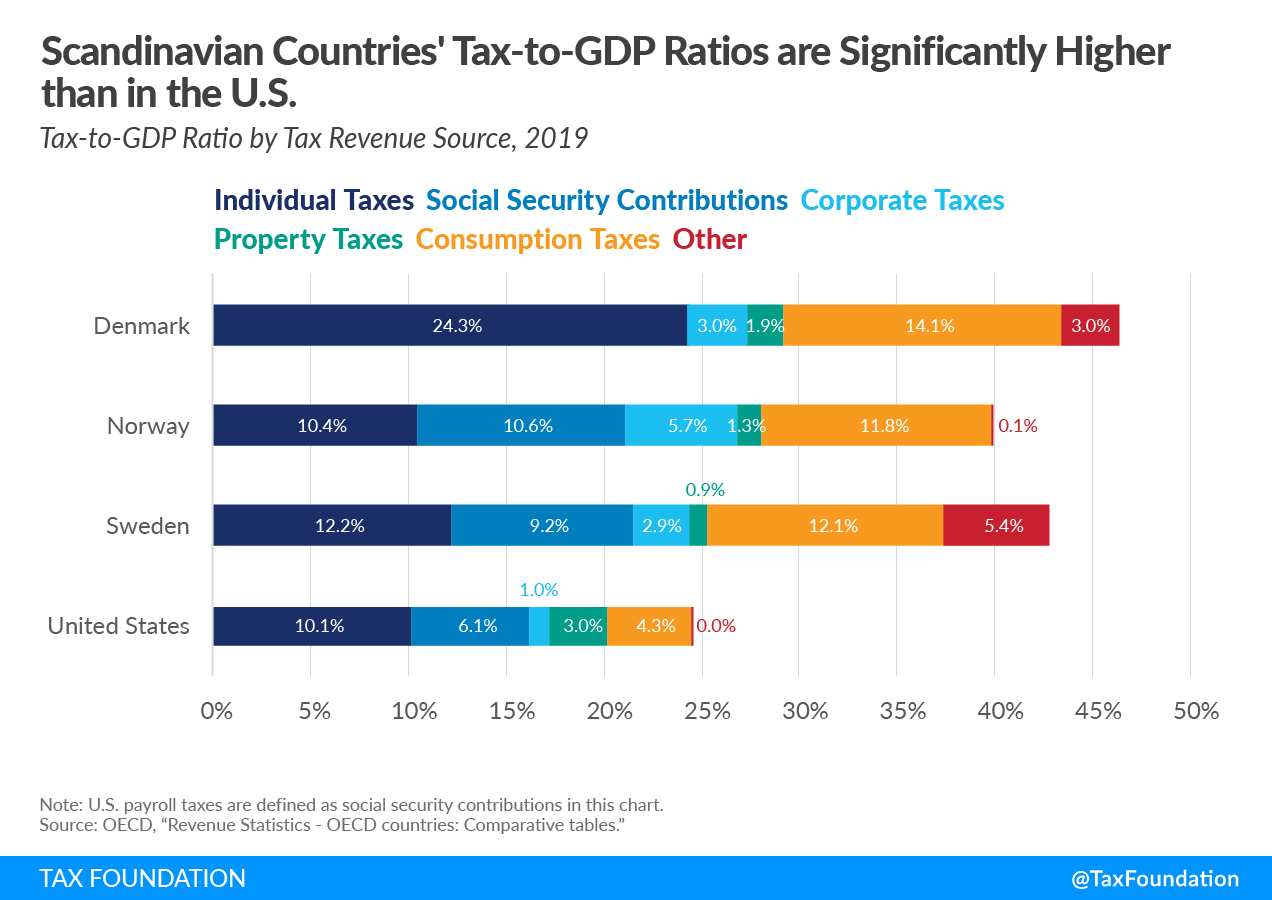
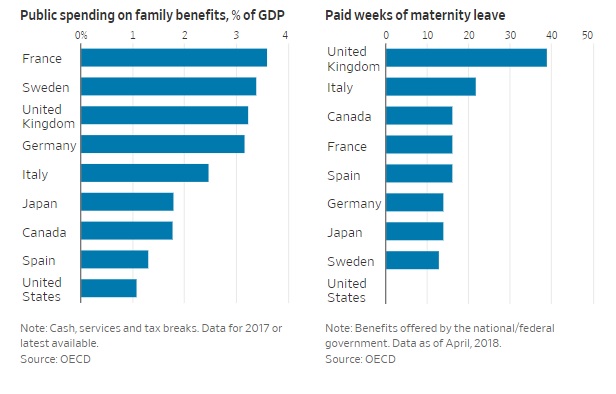
One could argue that there’s still plenty of room to fund more social spending through higher corporate taxes and higher top income-tax rates before talking about an economy-wide VAT. That, especially given higher income inequality in the US. But clearly creating Nordic America is going to require lots of additional revenue, whether through a VAT, carbon taxes, or a combination of both. Again the Tax Foundation: “In 2019, Denmark’s tax-to-GDP ratio was at 46.3 percent, Norway’s at 39.9 percent, and Sweden’s at 42.8 percent. This compares to a ratio of 24.5 percent in the United States.” And these WSJ charts highlight the current gap in social spending and spending commitments between the US and Europe:

It’s hard to avoid the reality — unless you’re a progressive politician, perhaps — of a fundamental mismatch between the left’s spending dreams and the economics of taxation. One caveat, which I point out in a recent The Week column:

Unless of course, Democrats adopt novel theories of macroeconomic policy that suggest significantly less need to pay for government spending. But there’s little evidence that anyone outside deeply left progressive politics or EconTwitter takes such ideas seriously. Certainly there’s no evidence that Federal Reserve Chairman Jerome Powell does, and he’s likely to be renominated for another term as boss of the central bank. If the far left really wants a transformational presidency — whether Biden’s or someone else’s — the lives of all Americans would need to fundamentally change.

Another Chinese Cultural Revolution Underway


The Disappearance Of Chinese Megastars Is A Harbinger Of Another Cultural Revolution Underway


by Helen Raleigh

Xi Jinping’s ongoing revolution has many similarities with Mao Zedong’s devastating Cultural Revolution. Policymakers need to quickly understand Xi’s ambitions.

Most people who have never heard of Zhao Wei likely never will now. Zhao was once a megastar in China’s entertainment industry, starring in many hit TV shows and films, such as “Red Cliff,” in the last two decades.

The 45-year-old actress was also known as a director, businesswoman, and investor. She had more than 85 million followers of her fan page on the microblogging platform Weibo. But in a matter of days at the end of August, Zhao “vanished” from China’s digital world.

The Chinese Internet was scrubbed of her interviews, movies, and TV shows. Searching for her on Weibo today, you will find nothing.

Zhao has never been officially charged with any wrongdoing, although some suspect her disappearance has something to do with her close relationship with Jack Ma, the outspoken founder of China’s largest e-commerce company, Alibaba. Ma himself disappeared after he criticized the Chinese government’s regulations on technology companies in October 2020.

Several other big-name celebrities vanished around the same time as Zhao. There are many indications that their digital disappearance results from Beijing’s latest crackdown. Beijing has ordered Chinese media companies not to select male actors or guests who appear “too effeminate.” ­

The Tea Leaves of Another Cultural Revolution

Within a day or two of Wei’s disappearance, a blog applauding the government’s actions went viral in China. It predicates “the red has returned” and “a profound transformation or revolution” is underway in China. The blog was written by Li Guangman and posted on WeChat, another Twitter-like Chinese social media platform.

Since Li is not well-known in China, few would have paid any attention to him in normal circumstances. Even in China, a fervent far-left Maoist like Li is in the minority. Yet something curious happened: all major state media, such as People’s Daily and other social media platforms, re-posted Li’s blog with the same headline: “Everyone Can Sense That a Profound Change is Underway!”

Welcome to Xi’s China’s Cultural Revolution 2.0.

Mark Twain famously said, “History doesn’t repeat itself, but it often rhymes.” That seems to ring true in Communist China. Xi Jinping, the leader of the Chinese Communist Party, has recently been cracking down on sectors such as tech, education, and entertainment in an attempt to reshape China’s culture and the economy more in line with socialist ideology.

Given that the Chinese government has the media industry under firm control, major state media would not have re-posted a blog from an unknown figure unless they received direct orders from someone higher up in the Chinese Communist Party’s propaganda department. Therefore, people began to speculate: did someone higher in the CCP tell Li to write such a piece, or did Li write it on his own, but someone important liked it and instructed prominent media outlets to share it? Was the widespread sharing by party mouthpieces such as People’s Daily meant to test the public’s reaction or represent an official endorsement of his call for a red revolution?

Parallels with Start of Mao’s Cultural Revolution

People who are familiar with Chinese history know that one of the critical triggers of Mao Zedong’s Cultural Revolution was the publication of dazibao (“big character poster”) on May 25, 1966, by Nie Yuanzi, a student at Beijing University. The poster with oversized Chinese characters denounced professors and administrators for their embrace of Western bourgeois values and lack of revolutionary spirit. Although Nie wrote the poster herself, she probably received help or even orders from senior party leaders in Chairman Mao’s inner circle, because soon after Mao directed People’s Daily to re-publish Nie’s poster.

Three months later, Mao launched the Cultural Revolution. Borrowing phrases from Nie’s big letter poster, Mao claimed bourgeois elements had permeated every aspect of Chinese society, from the government to schools, factories, and other institutions. They sought to restore capitalism and the party’s ability to exploit people.

Therefore, Mao insisted that only ferocious class struggles could eliminate these counter-revolutionary elements and ensure China was on its correct path to a Communist utopia. What followed was a decade of chaos and destruction throughout the country and complete isolation from the outside world.

During the Cultural Revolution, an estimated 20 million people perished, including senior party officials Mao regarded as his political enemies. China’s economy was on the brink of a total collapse, and cultural sites, relics, and countless properties were demolished or ravaged.

The Cultural Revolution only ended when Mao passed away in September 1976, but its damaging effects have lingered long after. The movement has left a severe psychological scar on the minds of the Chinese people born before 1980. This is why, when major state media re-posted a blog that was full of Maoist slogans and calling for the return of “profound revolution,” people both inside and outside China started to wonder: is Xi going for a Cultural Revolution 2.0?

Xi Models Mao

Chinese officials rushed out statements to calm the public and ease foreign investors’ fears that history would repeat itself. A front-page editorial in People’s Daily claims, “Opening to the outside world is China’s basic national policy, and this will not waver at any point.” However, such reassurance offers little comfort because action speaks louder than words. There are simply too many similarities between Xi’s revolution and Mao’s Cultural Revolution.

Unmistakably, Xi models his leadership style directly after Mao. Xi brazenly embraced efforts to build a cult of personality last seen in China under Mao. There are songs including lyrics such as “To follow you [Xi] is to follow the sun.”

The party’s propaganda machine has also showered him with great titles: “Core of the Party” and “Helmsman of the Nation.” These were superlatives last used to address Mao. The entire nation has been called to “unite tightly around President Xi.” Like Mao’s, Xi’s portraits are ubiquitous. Like Mao’s “little red book,” the collection of Xi’s speeches and instructions has been a national bestseller and is compulsory reading even for schoolchildren.

Xi is a fervent nationalist and socialist who believes socialism and China’s national identity are inseparable. Xi demands absolute obedience and loyalty not only from his party members but also from the general public. That’s why under his rule the Chinese people have seen increased surveillance, censorship, and the worst crackdown on dissent since Mao’s Cultural Revolution.

On the cultural front, Xi has done more than just making a few celebrities “disappear.” Like Mao, Xi demanded culture to serve as the party’s propaganda machine and assist the party’s aim to turn Chinese men into masculine and patriotic socialists.

Xi has banned Chinese youth from playing more than three hours of video games each week. At the same time, the scale and intensity of “red education,” which promotes unyielding loyalty to Xi and the party, has reached a level last seen during Mao’s Cultural Revolution.

Revolutionary songs praising the Chinese Communist Party have become popular once again. Movies that glorify the party’s deeds during the Second Sino-Japanese War and the Chinese Civil War have become blockbuster hits.

Capitalism a Phase on Road to Socialism

Xi’s Cultural Revolution 2.0 has gone beyond reshaping China’s culture. On the economic front, Xi has been trying to roll back the four decades of economic reforms launched by Deng Xiaoping and continued by Xi’s predecessors. According to The Wall Street Journal, Xi’s objective is to “get China back to the vision of Mao Zedong, who saw capitalism as a transitory phase on the road to socialism.”

Like Mao, Xi has launched a campaign against private businesses in China, including scrapping Ant Group’s record-setting $36 billion initial public offering; imposing a $2.8 billion fine on Ant’s parent company, Alibaba; and banning China’s private tutoring companies from making profits, which practically wiped out the entire industry.

Xi’s most socialist move was when he rolled out a new policy aiming to achieve “common prosperity,” a fancy name that is really about the redistribution of wealth from China’s rich business owners (excluding party members, of course). Xi publicly talked about the need to “regulate excessively high-income groups” and how “businesses should return more of their profits to society.”

Such talk is reminiscent of Mao’s “land reform” in 1950, which forcefully took land away from landowners and redistributed it to landless, poor farmers. A few years later, the government took land away from poor farmers and has nationalized land ownership since then. “Land reform” turned out to be a smokescreen for the party to demolish private property rights.

Responding to Xi’s new “rob the rich” policy, fearful private businesses in China moved swiftly to demonstrate their party loyalty and willingness to “return more of their profits to society.” Alibaba announced it would invest 100 billion yuan ($15.5 billion) over the next few years into “common prosperity” initiatives, including supporting vulnerable groups. Other tech companies made similar pledges too. Xi’s shakedown of the rich has been enormously effective.

While Mao’s Cultural Revolution was primarily a domestic affair, Xi’s ambition is to have socialist China dominate in the new world order. Not surprisingly, Xi’s Cultural Revolution 2.0 has already had a significant impact on the rest of the world. Xi’s economic crackdown has already sparked several rounds of substantial global stock market selloffs, wiping out $1.5 trillion in the value of Chinese companies he targeted. International investors have suffered enormous financial losses.

The sooner policymakers and investors in Western democracies understand Xi’s ambitions and ideological drive, the better they can develop policies and strategies to protect democracies and everything we cherish from the harms of a determined socialist and his revolution.

Helen Raleigh, CFA, is an American entrepreneur, writer, and speaker. She's a senior contributor at The Federalist. Her writings appear in other national media, including The Wall Street Journal and Fox News. Helen is the author of several books, including "Confucius Never Said" and “Backlash: How Communist China's Aggression Has Backfired." Follow her on Parler and Twitter: @HRaleighspeaks.

Václav Malý, el sacerdote que se enfrentó -y venció- al partido comunista más poderoso de Europa


Torturado, encarcelado y cesado, rezó el padrenuestro ante cientos de miles de personas


por José María Carrera / ReL


Fin de la Segunda Guerra Mundial. Desde que el Ejército Rojo entró en Praga y hasta 1946, el presidente checoslovaco Edvard Beneš deportó en represalia a toda la población de origen alemán. Ningún país europeo tenía tanta presencia germánica como Checoslovaquia.

Las deportaciones causaron una profunda enemistad. Desde entonces, un férreo régimen soviético impregnó la vida pública y privada de checos y eslovacos, y la Iglesia católica no fue una excepción. Arrestado en cientos de ocasiones, encarcelado y torturado, un sacerdote, Václav Malý, luchó incansablemente por defender la Iglesia, la libertad y la reconciliación. En reconocimiento a su labor, Alemania acaba de condecorarle con la Cruz Federal al Mérito.

Nacido entre dictaduras, conspiraciones y revolución: la primavera de Praga

Václav Malý nació el 21 de septiembre de 1950, en Praga. El mismo año de su nacimiento, la diputada y carismática Milada Horáková fue acusada aleatoriamente por el gobierno como cabeza de una presunta conspiración. El proceso judicial fue un auténtico teatro que se saldó con su condena a muerte el 27 de junio. Desde entonces, aquella fecha conmemora a las víctimas del régimen comunista.

Durante los años sesenta, la sociedad checoslovaca clamaba por el aperturismo del régimen. En 1968, el nuevo líder del partido, Alexander Dubcek, estableció la libertad de expresión y se concedió la amnistía a numerosos disidentes y presos políticos.

Aquel aperturismo no fue bien interpretado desde Moscú, especialmente tras la firma del Pacto de Varsovia, que se suponía garante de la unificación y colaboración mutua en el bloque soviético. La noche del 20 al 21 de agosto de 1968, 170.000 soldados y 4.600 tanques del Pacto de Varsovia –procedentes de la URSS, Bulgaria, Polonia, Alemania Oriental y Hungría- invadieron Checoslovaquia. El país cayó en pocas horas.

Tanque del Pacto de Varsovia.

Uno de los tanques del Pacto de Varsovia, durante la intervención de Checoslovaquia para frenar la primavera de Praga.

La Primavera de Praga había concluido, y el comunismo ortodoxo ocupó de nuevo las más altas instancias de poder en Checoslovaquia. Mientras, Malý comenzaba sus estudios en la Facultad de San Cirilo y Metodio en Litomerice. Tras una precoz vocación, fue ordenado sacerdote en 1976.

El objetivo del régimen, la aniquilación de la Iglesia

A partir de ese momento, el sacerdote fue verdaderamente consciente de los objetivos del régimen: “Destruir a la Iglesia y extraer la conciencia cristiana de la mente de las personas. La Iglesia fue sistemática e incesantemente perseguida en mi país”, contó a Radio Praga Internacional. 

El bienestar de los ciudadanos era la última de las preocupaciones gubernamentales y los derechos sociales, una ilusión. Miles de personas perdían sus empleos por sus convicciones, la práctica religiosa era limitada cuando no perseguida y en caso de conflicto entre gobernantes y ciudadanos, estos últimos no tenían posibilidad de defensa alguna.

El 1 de enero de 1977, un carismático opositor, Vaclav Havel, redactó y publicó la Carta 77, toda una declaración de intenciones frente al régimen solicitando la apertura. Malý fue uno de los primeros en firmarla.

Aquella suscripción dio comienzo en el sacerdote a una intensa oposición al régimen desde su postura religiosa e intelectual, lo que le valió la suspensión oficial de su permiso para ejercer como sacerdote y el arresto por “subversión frente a la república”.

El sacerdote había osado enfrentarse al Partido Comunista Checoslovaco, el más fuerte de Europa.

Hombre enfrentándose a un tanque soviético en Praga.

Pese a que la resistencia fue pacífica, en la primera jornada de la invasión de Checoslovaquia murieron 50 personas, 15 de los cuales fueron abatidos delante de la sede de Radio Praga.

Aquellos años, a muchos sacerdotes les prohibieron ejercer su ministerio públicamente. “Yo fui uno de ellos” afirma. “Estaba prácticamente prohibida la enseñanza de la religión, y los padres que enviaban a sus hijos a efectuar esos estudios debían saber que serían objeto de calumnias y de represión en el trabajo”.

Como ya recogió Religión en Libertad, según el historiador y disidente católico Radomir Maly "casi la mitad de los curas y religiosos se encontraron en prisiones y campos de trabajo". En la primera fase de persecución mataron a unos 65 clerigos y religiosos, entre checos y eslovacos. Más de 6.000 clérigos pasarían al menos 5 años en prisiones y campos de trabajo. En Eslovaquia la persecución fue aún más dura contra los católicos de rito oriental, cuya actividad quedó directamente prohibida y sus posesiones confiscadas.

Arrestado con asesinos y torturado, conoció "el pan que alimenta a los cristianos"

Incansable, Malý descendió a la clandestinidad religiosa. Fue arrestado más de doscientas veces, durante meses compartió celda con asesinos e incluso fue torturado.

“La represión era sumamente desagradable, aunque nos unía más y nos concentrábamos en lo importante. Tuvimos que darnos cuenta de cuál es el pan que alimenta a los cristianos, y de qué era lo fundamental para nosotros y para la existencia de la Iglesia”, rememora el Malý.

 “Había represión, momentos muy duros y limitaciones en todo orden de cosas. Estábamos aislados de la Iglesia a nivel internacional. Aquellos para quienes la fe era una mera tradición, se quedaron en el camino”. Tan solo permanecieron unidos aquellos que realmente sabían en lo que creían.

Lejos de amedrentarse, el sacerdote sentó filas junto a Havel, de quien fue portavoz desde 1989, mientras constituía un órgano de expresión católico desde la clandestinidad.

Un padrenuestro para enardecer a los anticomunistas

A finales de año, con el gobierno comunista desgastado por la oposición, cientos de miles de checoslovacos tomaron las calles exigiendo la convocatoria de elecciones libres, mientras los autores de la Carta 77 constituían el primer partido político opositor, el Foro Cívico.

Había estallado la Revolución de Terciopelo, y Malý fue uno de sus actores más destacados. Especialmente en la manifestación de la Planicie de Letná, en Praga, en la que más de más de 800.000 personas pedían la dimisión del gobierno comunista y la convocatoria de elecciones.

Manifestación de la plaza de Letná, el 26 de noviembre de 1989, con la intervención del sacerdote Václav Malý.  

“Fue una clara señal de que las personas querían un cambio. Ya no se trataba de unos cuantos miles de valientes, sino que se trataba de una inmensa masa de personas”, recuerda Malý.

En una ocasión, frente a cerca de un millón de personas, el sacerdote intervino para rezar el Padre Nuestro por la reconciliación con sus vecinos alemanes y por el futuro del país.

El alzamiento de los católicos ante la tiranía 

 Malý era consciente de que la gente presentía que el régimen se estaba debilitando, y además de escuchar y seguir a los oradores, no vacilaban en expresar sus inquietudes y su desacuerdo. “Los católicos alzaron la frente y comenzaron a manifestar su descontento por la política del régimen comunista hacia la Iglesia”.

“Nadie recurrió a las malas palabras, a pesar de que algunos momentos fueron bastante tensos. Sudé al tratar de mantener a esa masa de personas en calma”, explica Malý.

El 29 de diciembre de 1989, concluía la Revolución de Terciopelo. Habían logrado la claudicación del gobierno comunista, que reconoció la supresión del artículo legal que le concedía el monopolio político.

En junio de 1990, Foro Cívico obtuvo la victoria en las primeras elecciones libres.

La tarea pendiente tras la victoria: la reconciliación

Tras el triunfo de la Revolución y la caída del Muro de Berlín, Malý solicitó al gobierno la apertura de conversaciones con los alemanes de los sudetes y desde entonces, luchó activamente por la reconciliación entre los alemanes desplazados en 1946 y sus compatriotas checoslovacos.

El mismo año de la victoria de Foro Cívico, el sacerdote fue destinado a la parroquia de San Gabriel en Praga-Smichov, y los cinco años siguientes permaneció en la de San Antonio en Praga.

En 1996 fue nombrado obispo auxiliar de Praga, y desde entonces continúa transmitiendo activamente, como en los años del telón de acero, la primacía de los derechos de la Iglesia sobre toda ideología. 


 Fuente: Religión en Libertad

Synode sur la synodalité


 Vers une Eglise démocratique?

Analyse du Club des Hommes en Noir


Retrouvez Le Club des Hommes en Noir pour sa troisième saison. Cette émission fondée en 2012, sur une radio bien connue, par Philippe Maxence, a un concept simple : l'actualité de l'Église décryptée par des prêtres et un laïc. 

Le Club des Hommes en Noir est revenu sur l'annonce du Synode sur la synodalité, à l'occasion de la publication d'un document préparatoire. Philippe Maxence recevait l'abbé Celier, l'abbé Guelfucci, le Père Viot et Guillaume de Thieulloy. 


Abonnez-vous à L'Homme Nouveau et découvrez tous nos produits : Cliquez ici. 

Pour faire un don, aider le Club des Hommes en Noir et bénéficier d'une déduction fiscale : Cliquez là.


 Source: L´Homme Nouveau