| ||||||||||||||||||||||||||||||||||||||||||||||||||||||||||||||||||||||||||||||||||||||||||||
|
viernes, 6 de enero de 2017
“The Best Books I Read in 2016”


The self-designing worldview wherein there is no God is familiar enough today amidst the fluidity of gender ideology
When God’s Authorship of Creation is Denied
Your perversity is as though the potter
were taken to be the clay:
As though what is made should say of its maker,
“He did not make me!” (Isaiah 29:16)
These words are as pertinent today as when they were first spoken by the prophet Isaiah (ca 740-681 BC). If there is a God today, then he remains little more than a projection of human consciousness, readily revised at will. In a talk delivered in 1946, “Existentialism is a Humanism,” Jean-Paul Sartre (1905-1980) posited God’s non-existence in formulating his now famous phrase, “existence precedes essence.” Essence here is what defines a man or woman, what determines them to be who and what they are and have become. Sartre explained, “man first of all exists, encounters himself, surges up in the world—and defines himself afterwards.” He begins as “nothing… [and] will not be anything until later, and then he will be what he makes of himself. Thus, there is no human nature, because there is no God to have a conception of it.”
The self-designing worldview wherein there is no God is familiar enough today amidst the fluidity of gender ideology and the makeover marriage received in Obergefell vs. Hodges. But there is a subtler side to Sartre’s phrase, “existence precedes essence,” namely, the presumed conflict between God and the human condition at a fundamental, metaphysical level of reality. In fact, so pronounced is the conflict that Sartre’s humanism requires atheism; there can be no a priori laws (like the decalogue) or values (honesty, goodness, integrity) to which the human condition is beholden in advance. If there were, it would constitute “a self-deception” whereby “I am in contradiction with myself if I will these [a priori] values and at the same time say that they impose themselves upon me.” God and the necessary freedom for determining one’s essence cannot coexist. Yet man and woman are free to make something of themselves and, therefore, the conclusion follows: God does not exist.
And the conflict in the first instance is metaphysical, not psychological. The casualty of this worldview is the existence of God. It is also a photographic negative, the exact opposite, of how medieval theologians, like St. Bonaventure, understood existence. Bonaventure held that “essence precedes existence” where essence is a given form or design for a creature. The essence of a created entity precedes its existence in a twofold manner. First, it pre-exists in the Word from all eternity, since “the Father begot His own likeness, that is, the Word coeternal with Himself… and in so doing He expressed all that He could [including minuscule creation].”
...............
Read more: www.crisismagazine.com
The Pastoral and Moral Crises That Lie Ahead
 | |||||||||||||||||||||||||||||||||||||||||||||||||||||||||||||||||||||||||||


It is only a matter of time until Venezuela will default on its foreign debt.
Venezuela's March Toward Default
It is only a matter of time until Venezuela will default on its foreign debt. After a short peak in 2009, when the country’s foreign exchange reserves stood at over $40 billion, Venezuela has been steadily hemorrhaging its reserves down to $10 billion. In 2016, Venezuela started to sell gold in order to compensate for the loss of its monetary reserves. As a consequence, Venezuela’s gold reserves plunged from over 360 tons down to less than 190 tons. Other than in the case that some foreign power, such as China, for example, would jump in as a lender, Venezuela’s default seems unavoidable (graph 1).

Venezuela is not only the victim of falling oil prices although these have the strongest immediate effect on the country’s finances. Oil revenue finances more than half of Venezuela’s government budget and accounts for almost all export income. Venezuela’s deeper problem comes from the fact that almost all of the government’s so-called social benefits in the wake of the “Bolivarian Revolution” under presidents Hugo Chavez and Nicolás Maduro have been financed by monetary expansion.
In 1998, before Hugo Chavez became president, the extended broad money supply (M3) stood at 10.6 billion bolivars. By 2010, the Venezuelan money supply had already risen to more than 290 billion bolivars, and as of October 2016, money supply M3 reached 7,513.9 billion Venezuelan bolivars (graph 2).

Consequently, annual price inflation shot up from around 25 percent in the years before 2012 to over 180 percent by the end of 2015 until the government practically stopped publishing the official figure. The International Monetary Fund estimates an inflation rate of 480 percent for 2016 and of 1,640 percent for 2017.
Venezuela is not only the victim of falling oil prices although these have the strongest immediate effect on the country’s finances. Oil revenue finances more than half of Venezuela’s government budget and accounts for almost all export income. Venezuela’s deeper problem comes from the fact that almost all of the government’s so-called social benefits in the wake of the “Bolivarian Revolution” under presidents Hugo Chavez and Nicolás Maduro have been financed by monetary expansion.
In 1998, before Hugo Chavez became president, the extended broad money supply (M3) stood at 10.6 billion bolivars. By 2010, the Venezuelan money supply had already risen to more than 290 billion bolivars, and as of October 2016, money supply M3 reached 7,513.9 billion Venezuelan bolivars (graph 2).
Consequently, annual price inflation shot up from around 25 percent in the years before 2012 to over 180 percent by the end of 2015 until the government practically stopped publishing the official figure. The International Monetary Fund estimates an inflation rate of 480 percent for 2016 and of 1,640 percent for 2017.
Since 2012, the price of Venezuelan oil has dropped from $100 per barrel to less than $50. Due to political turmoil and socialization of the industry, the overall oil production of the country has fallen to a 13-year low in 2016. Venezuela’s exports that consist almost completely of oil have plummeted from a peak of $30.7 billion in the third quarter of 2008, to currently less than $10 billion per quarter. In February 2016, the Venezuelan government officially devalued its currency by 37 percent against the US dollar from 6.3 to 10 bolivars all the while when the black market rate stood at over 1,000 bolivars for one dollar.
The Bolivarian Revolution, which Hugo Chávez started in 1999, is coming to its end. Severe shortage of basic goods, food lines, exorbitant black market prices, the collapse of the currency and hyperinflation now afflict a country that claims to possess the highest proven oil reserves of the world.
It is only a matter of time until Venezuela can no longer finance its imports and social and political chaos of unprecedented proportions will afflict the country. The fallout will also affect Venezuela’s neighboring countries.
Was 2016 a historical turning point, or merely a year like many others?
A Decisive Year?
by Guy Sorman
For all the rhetoric about 2016, we won’t know its true significance for some time.
Was 2016 a historical turning point, or merely a year like many others? No one knows yet. The rioters who stormed the Bastille in Paris on July 14, 1789, had no idea that they were launching one of history’s great revolutions. Wine and the summer heat, some said, sparked their actions as much as republican ideals.
Stendahl immortalized this inability to grasp the true significance of an event as it occurs in the character of Fabrice in The Charterhouse of Parma. Fabrice fights with all his might against English and Prussian soldiers in the Battle of Waterloo, but he is unaware of the stakes of the struggle. Only afterward does he learn that he was part of a great event, now known as “Waterloo,” which marked the end of an empire and the birth of a new political order in Europe.
If we look back over 2016, we can observe at least three major phenomena: the resurgence of populism, the return of brute force to international relations, and the weakening of democracy. These trends have sent the media scrambling for meaning, but do they really portend our future? Perhaps we’re not looking in the right place. After all, when Jesus was born in Bethlehem, was anyone looking for him there other than three wise men?
Let’s assume for the sake of argument that 2016 was in fact a populist milestone, with Brexit, the unexpected election of Donald Trump in the United States, and the rise of conservative parties in France, Italy, Poland, the Netherlands, Austria, and Hungary. We should take a closer look at the meaning of the term “populist.” Populists usually define themselves as patriots who want to “take back” control of their destinies. They see themselves as alienated by policies concerning immigration, globalization, and, in Europe, Europeanization (as opposed to national identity). They are against cosmopolitan intrusions, and they position themselves as an authentic people through their devotion to culture, language, and origins. They are united more by their passions, though, than by solutions. Will populists push the international order toward a breakdown, and possible violence? Or will the gulf between populist promises and reality extinguish these enflamed passions? We don’t know yet.
Likewise, we don’t know whether the recourse to brute force will displace the art of diplomatic negotiation in 2017. Without question, the leaders of China, Russia, Turkey, and Syria believe that they have won major victories in 2016 by disregarding international law, human rights, the U.N., and international treaties. But here again, the crucial question—do these trends represent a new order, or a fleeting moment of weakness on the part of Western democracies?—will go unanswered for the time being.
Epoka, która rozpoczęła się 13 maja 1917 roku, jeszcze się nie zakończyła. Rosja się nie nawróciła ...
Światło z Fatimy
Mateusz Ziomber
Wiek XX widział wiele: komunizm i narodowy socjalizm, dwie wojny światowe i jedną „zimną”, kryzysy gospodarcze i polityczne, euforię powojennego optymizmu i życie w cieniu – jak się wydawało – nieuchronnej atomowej „apokalipsy”. Widział kolejne rewolucje i ich tragiczne skutki, wielkie przełomy i podążające za nimi fale rozczarowania. Łudzimy się myślą o oswojeniu historii, choć o przyszłości myślimy z optymizmem o wiele mniejszym niż poprzednie pokolenia. Tymczasem obraz sytuacji, w której ciągle się znajdujemy, został nam dany już sto lat temu. W Fatimie.
..................
miércoles, 4 de enero de 2017
Pour sortir de la pauvreté, il faut apprendre à respecter et apprécier les entrepreneurs.
Le miracle de la prospérité moderne
Par Daniel J. Mitchell, depuis les États-Unis.
Pourquoi certaines pays sont-ils riches et d’autres pauvres ? Comment expliquer que certaines nations échappent à la pauvreté alors que d’autres s’installent dans la misère ? Et si nous voulons aider les pays pauvres à prospérer, quelle est la bonne recette ?
Depuis que je suis économiste en finances publiques, je suis tenté de dire qu’une flat tax et qu’un État de taille réduite sont l’élixir de la prospérité, mais ces politiques ne sont qu’une pièce d’un plus grand puzzle. Un pays a également besoin d’une politique monétaire raisonnable, d’un marché ouvert, d’une réglementation modeste, et d’un État de droit. En d’autres termes, vous avez besoin d’un État de taille réduite et d’un libre marché.
Mais tout cela ne nous dit pas vraiment ce qui génère de la croissance.
Dans le passé, j’ai souligné l’importance de l’investissement et partagé un remarquable graphique montrant que les salariés gagnent davantage lorsque le capital investi est plus important (ce qui est la raison pour laquelle nous devrions éviter la double imposition punitive des revenus qui sont épargnés et investis).
Ce qui compte vraiment
Mais cela ne répond pas vraiment à la question. Après tout, si seul un capital investi plus important comptait, ne faudrait-il pas que l’État se contente d’assigner davantage d’épargne et d’investissement dans l’économie pour favoriser la prospérité ? Il y a autre chose qui compte. Une chose peut-être intangible, mais d’une grande importance.
Deirdre McCloskey, dans une courte vidéo de Learn Liberty, explique que ce sont les idées et l’innovation qui stimulent la croissance.
Traduction française de l’Institut Coppet. Si nécessaire, vous pouvez faire apparaître les sous-titres français en cliquant sur le bouton idoine.
C’est une excellente vidéo pour plusieurs raisons, mais deux points me semblent essentiels.
Tout d’abord, Deirdre indique que la liberté économique est importante, mais que la prospérité moderne a également été favorisée par une évolution culturelle. Les gens ont commencé à apprécier et respecter les entrepreneurs. Vous pouvez considérer cela comme une forme de capital social (et je pense que ces normes culturelles sont d’une importance cruciale pour une société prospère). Et les entrepreneurs sont les innovateurs qui comprennent la façon de combiner capital et travail en vue de générer davantage de production économique, c’est pourquoi ils jouent un rôle essentiel dans le renforcement de la prospérité.
La courbe en crosse de hockey
Ensuite, elle nous rappelle que la pauvreté est la condition humaine normale et que l’ère moderne est vraiment un changement surprenant. De fait, j’ai été tellement stupéfié par les chiffres avancés que je me devais d’aller vérifier qu’elle n’exagérait pas. Eh bien non. À partir des données compilées par Angus Maddison, je suis allé voir si Deirdre avait raison de dire que le développement de la prospérité mondiale ressemble à une crosse de hockey.
Effectivement, il y a bien eu une progression étonnante de la prospérité à partir de 1800 environ, tout comme elle l’explique. En fait, elle aurait pu dire que les gens vivaient avec moins de 2 $ par jour pendant une bonne partie de l’histoire.
Voici les chiffres de la production économique mondiale par habitant au cours des deux mille dernières années.
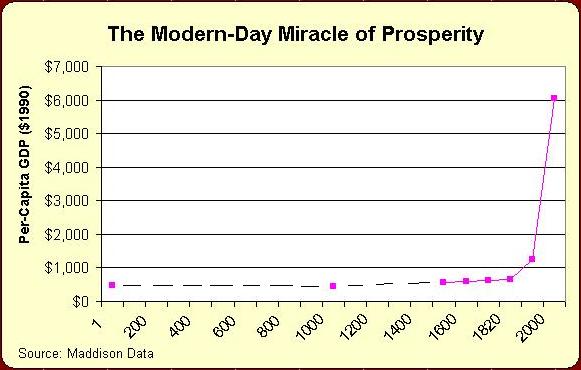
Incroyable. Et contrairement à la crosse de hockey controversée des alarmistes du réchauffement climatique, celle-ci est bien réelle. Elle illustre le fait que l’économie n’est absolument pas un gâteau fixe lorsque de bonnes politiques — et de bonnes attitudes — prévalent.
Alors, quelle est la morale de l’histoire ? La leçon la plus évidente est certainement que nous devrions respecter et apprécier les entrepreneurs et autres créateurs de richesse. Malheureusement, nous vivons à une époque où les politiciens veulent nous faire croire que le gâteau économique est fixe et que c’est le rôle de l’État de le redécouper au moyen d’une politique fiscale de lutte des classes et autres politiques de redistributions.
Suscribirse a:
Entradas (Atom)