Translate

miércoles, 29 de junio de 2016

Je n'aime pas la dictature, la haine politique, le credo du parti unique. Antoine de Saint-Exupéry

Le 29 juin 1900 : naissance d'Antoine de Saint-Exupéry.

Source: lesalonbeige.blogs.com


Antoine Marie Jean-Baptiste Roger de Saint-Exupéry est un écrivain et aviateur français. Il est né le 29 juin 1900 à Lyon. Il s'oriente vers les beaux-arts, avant de devenir pilote d'aviation suite à son service militaire. En parallèle de son emploi à l'aéropostale, Saint-Exupéry écrit de nombreux romans. Il disparaît en vol le 31 juillet 1944.

Son expérience de pionnier de l'aviation et de pilote de guerre lui donnera toute la légitimité pour délivrer son principal message : c'est par le dépassement de soi que l'on devient un Homme. Parmi ses principaux livres se trouvent :

  • L'Aviateur
  • Courrier sud
  • Vol de nuit (Prix Femina)
  • Terre des hommes
  • Pilote de guerre
  • Lettre à un otage
  • Le Petit Prince
  • Citadelle, (ouvrage posthume)


Très remonté contre la politique des gaullistes voici quelques extraits de ce qu'il écrit pendant la guerre :

« Dites la vérité, Général, la France a perdu la guerre, mais ses alliés la gagneront. » (Écrits de guerre, 1939-1944, Gallimard, Folio, p. 208)

« L'armée qui reculait n'était plus une armée […] La France a joué son rôle […] Les vaincus doivent se taire comme les graines. » (Pilote de guerre)

«Il me semblait qu'un Français à l'étranger devait se faire témoin à décharge et non à charge de son pays (EG, p. 286) […] Si je n'étais pas gaulliste à New York, c'est que leur politique de haine n'était point pour moi la vérité » (Écrits de guerre, 1939-1944, Gallimard, Folio, p. 269).

« J'ai eu raison, je crois, dans tout ce que j'ai pensé depuis deux ans sur les affaires de mon pays. Je n'aime pas plus aujourd'hui le général De Gaulle. C'est ça, la menace de dictature. C'est ça, le national-socialisme. Je n'aime pas la dictature, la haine politique, le credo du parti unique. Quand le national-socialisme meurt ailleurs, ce n'est vraiment pas raisonnable de le réinventer pour la France. Je suis très impressionné par cette bande de fous. Leur appétit de massacre entre Français, leurs souhaits en ce qui concerne la politique d'après-guerre (bloc européen) conduira une France aussi affaiblie que l'Espagne à ne plus être qu'un satellite de la Russie ou de l'Allemagne. Ce n'est pas dans cette direction que loge pour moi la vérité. » (Écrits de guerre, 1939-1944, Gallimard, Folio, p. 272-273)

« Je continue de penser que le salut de mon pays ne réside point dans une épuration sanglante par les fanatiques du « parti unique » ». (Écrits de guerre, 1939-1944, Gallimard, Folio, p. 286)

martes, 28 de junio de 2016

Il Discorso di Benedetto XVI nel suo 65esimo anniversario di ordinazione sacerdotale, nella Sala Clementina del Palazzo Apostolico. 28 giugno 2016


https://youtu.be/8tWli4is0pI


Leggi tutto. www.tempi.it

Those masterpieces whose creation is cut short by the death of a master resound with both human experience and human existence


The Unsolved Mystery of Mr. Dickens

by SEAN FITZPATRICK


June 9, 1870. Charles Dickens sat writing at his desk. He had been laboring more than was his custom on his latest book. Though the story was progressing well, Mr. Dickens was not feeling well. His left hand clawed at the air. His left foot dragged on the ground. And though he had recently retired from public performances with a final reading from Pickwick, his pen scarcely ceased its scratching. A profound and perplexing mystery was unfolding beneath that pen and Mr. Dickens’ knew it well. If only his readers might know it as well.

It had been five years to the very day since the Staplehurst train wreck and Charles Dickens had never quite recovered from the accident. After rescuing terrified victims from derailed carriages and desperately trying to help people who died in his arms, the great novelist was driven to a nervous state of deterioration that could not keep up with his feverish work habits as England’s favorite author. But he was bringing an exciting story to life. A book he called “very curious and new.”

It was not finished yet, but what were the effects of exhaustion and oncoming cerebral hemorrhage to Charles Dickens? The book was not yet finished. And it would be finished, sir, or he would die writing it. He would. Nevertheless, even he had a mysterious premonition of death and—as he would have done if he had been a character in one of his novels—he added a foreboding clause to his contract which he had never done before, making provision if the said Charles Dickens should die before the said work was completed.

Visibly and admittedly ill on that June evening after writing throughout the day, Mr. Dickens rose from the dinner table. His sister-in-law suggested that he lie down on the sofa. Turning as if to do so, he collapsed. “On the ground,” he said. Charles Dickens, aged fifty-eight years, was placed in the ground at Westminster Abbey without uttering another word, much less writing another word. When news of Dickens’ tragic death reached American shores, his friend Henry Wadsworth Longfellow wrote, “I hope his book is finished… It would be too sad to think the pen had fallen from his hand and left it incomplete.” The book was not finished. The manuscript of The Mystery of Edwin Drood remained on his desk as he had left it, incomplete.

Charles Dickens gave the world fourteen novels and one mystery, and that mystery is worth reading—eminently worth reading. It is one of the few stories whose ending cannot be given away. Instead, the ending, or the dying point, leaves every reader with their own catharsis. It is a story about death in a delightfully dark Dickensian town; a story that is more about death than Dickens knew—or did he? Cloisterham, with its great gothic cathedral, sets the strange gothic scene for the sinister, opium-smoking organist John Jasper and the strangling relationship he has with his nephew, the young architect, Edwin Drood.

So the mystery unfolds. Jasper confesses the torments of unrealized aspirations. Drood releases his betrothed, Rosa Budd. Minor Canon Crisparkle accepts custody over the wayward orphans Neville and Helena Landless from the misanthropic philanthropist, Mr. Honeythunder. Mr. Sapsea, the most self-important ass in the entire Dickens canon since Mr. Pecksniff, reveals his lofty epitaph. Durdles, the dusty and bedraggled stone mason, shows his skill sounding for hidden graves in the cathedral crypt to a keen Mr. Jasper. Mr. Grewgious, the jittery lawyer whose manner and speech are punctuated by a paralytic caution, produces a wedding ring for Edwin. The Princess Puffer, or Opium Sal, the dreadful drab who supplies Jasper with his drugs, harbors a violent vendetta. Then, on a stormy Christmas Eve, after an argument with Neville Landless, Edwin Drood disappears. Landless leaves Cloisterham. Drood’s pocket watch is found in the river weir. Suspicions fly. Jasper is desperately beside himself, torn by something in between love and hate, between justice and guilt. Grewgious begins asking veiled questions. Princess Puffer begins making veiled accusations. And Dick Datchery, the bespectacled stranger with wild white hair who never wears his hat, appears in Cloisterham to rend the veil for all.

But the veil remains intact. The pen of Dickens fell on the ground with its master. Why did Edwin Drood disappear? And where? Was it murder? As Andrew Lang said, “If Edwin Drood is dead, there is not much mystery about him.” And thus the theories over the existing portion of the novel and the fate, and even the future, of Edwin Drood abound and are a joy to peruse. They present a literary pleasure that only an unfinished work can offer, though it comes with a degree of pain that is deeply meaningful. Sunt lacrimae rerum.

............


It was Sunday, October 19, 1595 when he left the Tower ...


A Model of Spiritual Courage for Our Time


Quanto plus afflictionis pro Christo in hoc saeculo, tanto plus gloriae cum Christo in futuro. (The more affliction we endure for Christ in this world, the more glory we shall obtain with Christ in the next.)
Words inscribed by Philip Howard upon the wall of his cell.

When he first entered the fastness of that grim London fortress from which so few ever return, young Philip Howard was only twenty-eight years of age, his sudden incarceration the result of a failed attempt to flee the country with his family. That he was the Earl of Arundel, scion of the noblest and most respected family in the realm, not to mention a former court favorite of his second cousin the Queen, counted not at all amidst the crude and cynical calculations of those in power. His own father, after all, the 4th Duke of Norfolk, long accustomed to moving in the highest possible circles of power and prestige in the country, had himself been executed for High Treason only a few years before. Why should they spare the eldest son? Because he wasn’t a traitor? Alas, not even the certainty of innocence would be permitted to stand in the way of an egregious exercise of injustice. The tyranny of the times, I am saying, would exact its cruelest revenge despite all the obvious exonerating circumstances.

So what had poor Philip done to draw such murderous attention? And it was surely that inasmuch as it was deliberately intended that he should spend the rest of his life wasting away in a prison cell, a dark and fetid place where, almost eleven years later, he would finally die of dysentery. The answer is quite simple. He had become a Roman Catholic, no greater infamy than which can be conceived in the world of Elizabeth I.

She and her compatriots had compiled quite a record by then of coercing and killing anyone who dared to resist the totalizing aims of the Anglican Settlement. And it is chiefly that fact which distinguishes the forty-five years she spent as England’s monarch, despite all the contortions of the mythologists anxious to portray her as Good Queen Bess, the Virgin Queen, who made England great again. It is all bosh. But those who persist in believing it have carried the day; it is their view that continues to shape the reading of the past. And what it testifies to, of course, is the triumph of Whiggery, which is the view that stipulates the iron necessity that whatever the cause was that won, will perforce become the cause that bloody well should have won. Because Elizabeth Tudor, no less than her father Henry before her, and let us not forget the whole thuggish crowd of Cromwells and Cecils that serviced the Crown, were absolutely agreed about one thing, namely the complete destruction of the Catholic Thing. By their combined efforts they pretty much succeeded in uprooting the entire landscape of what had heretofore been Catholic England. Thus establishing an entirely new historical narrative, which is that everything that happened pursuant to the annihilation of the ancient faith simply had to happen. That England became Protestant during the years of the Tudor dynasty is no surprise, therefore, since the whole point of their governance was the replacement of one religion with another. The imprisonment and death of papists like Philip Howard was the price that needed to be paid to secure that end.

So why leave intact so much evidence of innocence and integrity? If the ultimate aim of the self-styled Reformers was to expunge even the remotest memory of Catholicism from the consciousness of ordinary Englishmen, especially in light of their fixed belief that Rome was the Anti-Christ, one would think they’d have been a bit more thorough in removing the tokens of Catholic piety from among the recusant population.

.............


Confidence in human progress led some to believe that, with the help of modern technologies, wars could be fought with minimal cost in life and treasure.


The Somme, 1916

Funeral of a great myth


By JOSEPH LOCONTE

At 7 a.m. on July 1, 1916, the British Army unleashed a hellish assault against German positions on the Western Front in France, along the River Somme. The roar was so loud that it was heard in London, nearly 200 miles away. The barrage​—​about 3,500 shells a minute​—​was designed to obliterate the deepest dugouts and severely compromise German artillery and machine-gun power. Crossing No Man's Land, that dreadful death zone stretching between opposing enemy trenches, would be a song.

Thus, at 7:30 a.m., nearly a hundred thousand British troops​—​to the sound of whistles, drums, and bagpipes​—​climbed out of their trenches and attacked. Like other great battles, this one was supposed to break the back of the German Army and hasten the end of the war. But the Germans had endured the pounding and were waiting, guns poised, for the British infantry. "We didn't have to aim," said a German machine-gunner. "We just fired into them." Before the day was over, 19,240 British soldiers lay dead, nearly twice that number wounded. Most were killed in the first hour of the attack, many within the first minutes.

July 1, 1916, marks the deadliest single day in British military history. Sir Frank Fox, a regimental historian, summarized the scene this way: "In that field of fire nothing could live." The Battle of the Somme would rage on, inconclusively, until November 18, dragging over a million men into its vortex of suffering and death.

Twenty-four-year-old J. R. R. Tolkien, a second lieutenant in the British Expeditionary Force, was among their number​—​an experience that would shape the course of his life and literary career. Tolkien spent nearly four months in the trenches of the Somme valley, often under intense enemy fire. As he recalled years later: "One has indeed personally to come under the shadow of war to feel its full oppression." A hundred years hence and the Somme offensive still casts its oppressive shadow across the landscape of the West. It symbolizes not only the human tragedy of an ill-conceived war but the fearsome cost of a mistaken idea: the notion of human perfectibility.

............


https://youtu.be/u8j1Jqo7Y7c


https://youtu.be/XVEHlPEV5g0


Homer had long ago asked the philosophical and moral questions that Plato asked


SONG OF TROY


By: Anthony Esolen


DOWNLOAD ARTICLE PDF


Sometime around the 14th Century before Christ, a wealthy city near the coast of modern Turkey was destroyed by raiders coming from the west, and the plains of windy Troy knew her no more. Then the raiders themselves and their civilization, centered, we believe, in the city of Mycenae in Greece, overrun by invaders, also passed away, along with their language and their system of writing, and centuries of cultural darkness descended upon the land. But the stories of Troy did not pass into utter oblivion. It is hard for modern men to grasp how powerful the human memory can be, when praise of the gods or of bygone heroes is crafted in song. Troy fell, but the names and the deeds of her legendary attackers and defenders, whether or not they existed in fact—Agamemnon, Achilles, Menelaus, Odysseus, Paris, Aeneas, Hector—did not.

Imagine journeying on foot through a vast cold upland desert, here and there littered with signs that men once dwelt there and flourished; a broken column, shards of pottery, an arm from a statue, a sword riddled with rust. Then you climb a high ridge and all at once you see below you a town bustling with action. There are gardens and orchards, and a broad deep river, and men building barges to float their goods to other towns downstream. There are large, handsome public buildings, with scribes recording the proceedings. There is a knot of boys sitting on the ground in front of a man with a white beard, instructing them in heroic song. Something like that is what happened when Greece awoke from her dark age, and, according to tradition, a blind poet named Homer, at the dawn of Western civilization itself, composed what many people consider to be our first and greatest songs, the Iliad and the Odyssey.

Modern scholarship has not so much cast that legend in doubt as it has enriched it and made it appear, in some ways, more wondrous still. For whoever composed the Iliad—we may as well call him Homer—was living in an age that saw the beginning of what we know as the Greek polis, while “remembering” a civilization of kings and the brute ethics of the warrior. He was living in an age that saw the beginning of philosophical and scientific investigation, while “remembering” the intractable passions that beat in the heart of man. He wove together songs from the misty past for the people who lived in his own time, with many a mysterious word and custom surviving in his poem like clues to a world gone by.

* * *

Even his religion partook of this strange, enriching half-memory. The peoples of the Mediterranean worshiped fertility gods, associated with the dark bowels of the earth-mother, the womb of all things and their destined tomb. The invaders who destroyed Mycenae, rich in gold, did not. They came from the steppes of Eurasia, with the great open sky above them. Their gods dwelt above, in light. They spoke an Indo-European language, related to what their cultural cousins would be speaking in Italy and Scandinavia and the British Isles and Persia and India. From them the Greeks derived their new, youthful gods of Olympus, dwelling atop the mountain where they drank not blood but ambrosia, where, along with the intrigue and violence that are inseparable from all polytheistic systems, they knew celebration and laughter and song. The fertility gods were banished to the underworld, where they too were “remembered,” just as Mycenae was remembered: Mother Earth, Night, Cronus, most of the Titans, the Furies, and Death, most hated of all the gods, because Death will not listen to appeal.

And so it was that the Greeks were fairly compelled to ask the questions that we associate with the height of their intellectual flourishing: What is the relationship between reason and the passions? What do we make of the conflict between a man’s desire for glory and his duty to his companions? What is the authority of a ruler when the common good is in question? In what does a truly good life consist? No matter what my beloved Plato said when he banished the poets from his imaginary republic, Homer had long ago asked the philosophical and moral questions that Plato asked, and we might justifiably say that only Greece, so strangely situated as she was, could have brought us both.

................


Mary Eberstadt argues that secular progressivism is not just a political ideology; it is a competing faith


From Salem to DC: Mary Eberstadt’s Analysis of the Dangerous Religion of Secular Progressivism


by Luma Simms

"People of faith—especially Christians who adhere to traditional religious beliefs—face widespread discrimination in today’s increasingly secular society. "

During my first few weeks in America, I vividly remember my mom gasping in surprise and pointing out a large cross on a hill overlooking the freeway in southern California. As my dad tried to concentrate on driving, my mother exclaimed with amazement (in Arabic): “They allow crosses on hills in America!” My father brought me to America so that I could have freedom of religion, freedom of expression, and freedom of thought. We never thought that they would be curtailed. We never thought that a day would come when people would agitate over crosses on hills, the Decalogue in courthouses, and pro-life pins on lapels. My father brought me here. If this trajectory continues, where might I take my children?

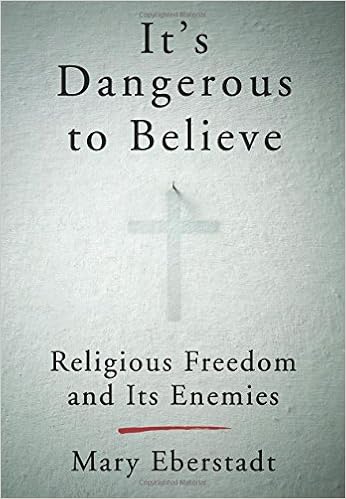
This is the precise question with which Mary Eberstadt begins the introduction to her small but mighty book, It’s Dangerous to Believe: Religious Freedom and Its Enemies. Faced with hardships, vilifications, and discriminations great and small, many believers have begun to ask: “Where will we go?” Inspired by their experiences, Eberstadt offers an extended meditation on secular progressivism’s “soft persecution” of Christians and religious freedom.

But we can’t comprehend our current cultural clashes without understanding the history that gave rise to the new intolerance of today. Knowing this, Eberstadt walks us briefly from the philosophical skepticism of Voltaire to twentieth-century anti-religious campaigns. A little more than a decade ago, assaults on religious liberty and on Christian men and women began to accelerate and escalate. Eberstadt points to two seismic cultural events that contributed to this escalation: first, the terrorist attacks of September 11; and second, the Catholic Church’s catastrophic sex abuse scandals. Together, these two events gave not only the “new atheism” movement but all unbelievers the impetus to start clearing away the vestiges of American religion. Eberstadt recounts the evidence of discrimination, financial bullying, legal warfare, harassment, social media shaming, and many other forms of intimidation used by secular progressive activists to shut down Christians.

Eberstadt is a superb analyst. Her hypothesis—carefully demonstrated and ringing true—is that secular progressivism is not just a political ideology; it is a competing faith, a religion. It is a secular faith that emerged out of the sexual revolution. This faith is Kantian in nature, following the categorical imperative as an ethical guide. The messianic political religion that is secular progressivism has its own theology, creed, morality, saints, demons, missionaries, proselytizers, and sacraments. It has its own alternative orthodoxy, which mimics Christianity. Its messiah is a liberated sexuality, and its first principles are the “primacy of pleasure and self-will.”

Eberstadt’s framing of the movement in this way does not represent some hyperbolic or imagined Christian martyr complex. The notion that secular progressivism operates as a faith may not be novel, but it is a valuable paradigm, worth exploring deeply. She leads the way in this exploration, calling for a change in our engagement. The strategies she lays out will involve convincing open-minded secularists that it is in everyone’s interest to return to the basics of a free society—a society in which we allow others to hold different beliefs without ostracizing them. But first we need to pull back from the current collective hysteria, scare tactics, and witch hunts.

Modern Witch Hunts

Eberstadt shows the similarities between the Salem witch trials, the environment surrounding the forged Protocols of the Elders of Zion, Nazi anti-Semitism, the Red Scare, McCarthyism, and—most recently—the collective panic in the 1980s over day-cares abusing children. As she skillfully demonstrates, the same mechanism is being used by today’s secular progressives against Christians: isolation, stigmatization, and social and economic punishments. The epithets themselves have morphed: “‘bigot’ and ‘hater’ are the new ‘wizard’ and ‘witch,’” she notes. These “Salem-esque” hunts are conducted with “inquisitorial zeal” and flimsy evidence. In the new dispensation of the sexual revolution, Eberstadt writes, “yesterday’s ‘sinners’ have become the new secular saints; and yesterday’s ‘sins’ have become virtues, as positive expressions of freedom.” Anyone still holding to traditional sexual mores will pay the price. In effect, Christians in America have become second-class citizens: dhimmis.

Where does one begin enumerating this new aggression against traditional Christians? Eberstadt examines story after story. Because of its fealty to biblical moral teachings, InterVarsity Christian Fellowship was kicked out of all twenty-three California State University campuses; it has been purged from other colleges around the country and continues to be challenged. After forty years of being on campus at California State Stanislaus, the Christian group Chi Alpha was stripped of official recognition. The student chapter of the Christian Legal Society at Hastings College of Law was denied campus status. There have been attacks on Christian homeschoolers, Catholic adoption agencies, and Christian colleges. A Christian day-care staff member was fired for not addressing a six-year-old girl as a transgender boy, and an adjunct professor was suspended for teaching natural law as part of a modern Catholic social thought class.

Eberstadt also writes about Ryan Anderson, the editor of this journal, who has had to bear more than his share of shaming and harassment. “His public appearances are now lightning rods for ideological malevolence of a kind without counterpart elsewhere on the spectrum,” Eberstadt writes. This exchange between Anderson and a New York Times reporter moved me to tears:
[While] Anderson repeatedly made the case for civility and respect for opposing perspectives, the reporter responded with “Why shouldn’t I call you names?” and “Civility is not always a virtue” and “Some people are deserving of incivility” and “obviously some policy views render people unworthy of respect.” Anderson explained, “people are always worthy of respect, even if their policy views are misguided. Nothing renders people ‘unworthy of respect.’” He continued: “I think even when we vehemently disagree with someone the person still has innate human dignity, still worthy of respect.”
The common denominator beneath all these witch hunts “is the protection of the perceived prerogatives of the sexual revolution at all costs,” writes Eberstadt. In essence, believers are seen as a threat to laissez-faire sexual morality. What is going on under the surface of these clashes? What is it driving these people to shut down even charities, whose sole business is feeding the hungry, sheltering the orphan, and helping the poor? Eberstadt sees “deep creedal passions.” She writes:
they do not think what they do is deplorable. They believe they are in possession of a higher truth, and they fight to universalize it—to proselytize just as anyone else who believes himself charged with guardianship of the Truth seeks to do.
The so-called culture wars are not about libertarian freedom versus religious unfreedom. They’re about a conflict between two rival faiths. [Emphasis added]

One of the most disheartening results of these witch hunts is their destruction of charitable works. Intimidating and litigating charities out of existence has a steep price, and those who pay it are the poor and needy. Christianity has a two-thousand-year history of ministering to those in need. If religious institutions and infrastructure that have been built over the years are shut down, they will not be easily replaced by secular organizations. As Eberstadt puts it: “the organically grown, intricate, transnational networks built by Christians and their charities in the course of years, decades, and even centuries are not replaceable—not overnight, not a hundred years from now, and certainly not by governmental bureaucracies.”

What Can Christians Do?

In spite of all of these disheartening social trends, Eberstadt does a commanding job justifying a strategy of active, hopeful, patient engagement. This is where Eberstadt’s wisdom really shines.

Believers of every stripe need to come to terms with what is going on. We must gain clarity about secular creeds and their competing first principles. We need to understand that this competition may be unavoidable, but its result is far from inevitable. This attempted redefinition of humanity is not some Hegelian process that takes us one way through history to a new tomorrow. There are two possible choices for adherents of the new faith born out of the sexual revolution. They can either follow their Puritan forebears by punishing all who are “heretics,” or, Eberstadt writes, “they can opt for what Thomas Jefferson and other Founders developed as an antidote to Puritan destructiveness, namely, the shared understanding that one’s own liberty isn’t safe until everyone else’s is protected.”

Just like other religions, the secular progressive faith must unite faith with reason. This is what will pull them back from sabotaging the entire American project. And although Eberstadt doesn’t necessary put it in those terms, that is what she is calling for by making an appeal to open-minded secularists of good will—those who value genuine diversity in the realm of ideas—to remember what true liberalism entails. An intra-secular conversation leading to a more temperate secular faith should be encouraged. There is now in the secular progressive camp a feverish adherence to its orthodoxy without the balance of reason. Only secular progressives themselves can rein in their own unruly activists, their extremists.

Eberstadt offers a key insight into the events that finally ended the terror of the Salem witch trials, the Red Scare, and McCathyism: people on the persecutors’ side acknowledged that things had gone too far. Someone must echo the words of army counsel Joseph Welch to Joseph McCarthy: “You’ve done enough. Have you no sense of decency, sir, at long last? Have you left no sense of decency?” If today’s believers and unbelievers are to live together as the Founding Fathers had envisioned, if we want to regain and keep our free society as it was intended, then “about matters concerning the sexual revolution,” Eberstadt writes, “as about other articles of deeply held faith, people must agree to disagree. That is the sine qua non of a more civil tomorrow.”

The vindictiveness of secular progressives is real, and there’s a lot of it. Eberstadt’s examples leave one with the impression that secularists are barely holding back from muttering “now it’s your turn to be suppressed and subjugated.” Only Christian love can absorb that kind of hatred. We are capable of spiritual, moral, and political renewal. We have the spiritual and intellectual patrimony to bring true tolerance and civility back to America. The Christian moral code has endured minority status before and overcome—it evangelized from the catacombs. It will be the beauty of living out the truth of Christianity, not just asserting them, that will change hearts.

The sexual revolution has given rise to “counterrevolutionaries—people who are persuaded toward religion itself, and act upon their convictions.” Men and women, battered by years spent believing and living the empty lies of the sexual revolution, are being awakened. “Christianity,” Eberstadt observes “is being built more and more by these witnesses—by people who have come to embrace the difficult, long-standing rulebook not because they know nothing of the revolution and its fallout, but because they know too much.” Watching this spiritual renaissance around us should give us hope.

Luma Simms is a writer whose work has appeared at First Things, The Federalist, and Public Discourse.

Read more here: www.thepublicdiscourse.com